 English
  Arabic
  Spanish
  German
 Most importers treat custom glass samples like a box-ticking exercise—one piece, a quick look, and then straight to bulk production. In ten years of managing high borosilicate glass manufacturing, I’ve seen that pattern cause more rework, delay, and outright rejection than any other single factor. A single sample rarely reveals how a design will behave across an entire production run, especially when decoration, annealing, or tight dimensional tolerances are part of the specification. The number of samples you need depends on what you’re verifying and how much risk you’re willing to absorb before tooling commits you to thousands of units.
What Determines the Right Number of Custom Glass Samples
Custom glass design isn’t just about the shape. A sample must confirm that the glass body, decoration, lid fit, and thermal performance all work together under real production conditions. Three main variables drive the sample quantity decision.
First, the manufacturing process the design requires. Machine-pressed borosilicate glass cups come out of a mold with consistent wall thickness, but hand-assembled items—like a jar with a wooden lid and silicone gasket—introduce assembly variables that a single sample won’t expose. Our facility runs 100 automated forming lines producing 200,000 pieces daily; even with that level of automation, a new mold profile often needs two or three sample pieces before we’re confident the wall thickness distribution meets spec at every measurement point.
Second, the decoration method. Silk-screen printing on a curved glass surface can shift slightly depending on glass temperature and squeegee pressure. Decal application on a textured surface can leave bubbles that only appear after annealing. If your design includes multi-color printing or a decal that wraps around a handle, I recommend ordering at least three decorated samples from different production batches. It costs more than one, but it costs far less than discovering inconsistent logo placement after 5,000 pieces are printed.
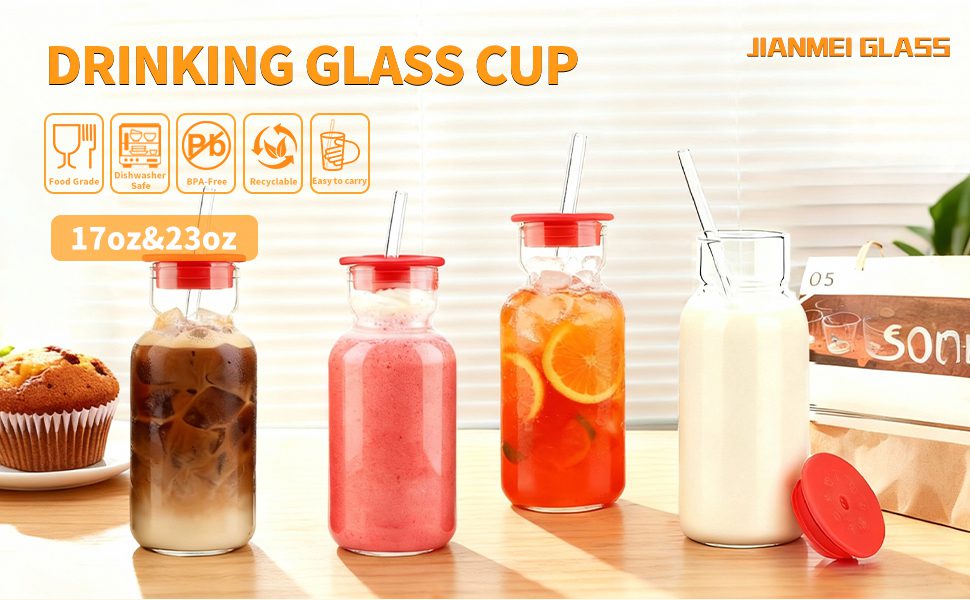
Third, whether the design uses any component that isn’t pure borosilicate glass. A stainless steel lid with a silicone seal, a bamboo lid, or a plastic straw cap—each of these creates a tolerance stack. The glass neck diameter, the lid thread, and the seal compression all need to be verified together. Ordering five or more full assemblies isn’t unreasonable for a new SKU that combines three material interfaces.
Evaluating Glass Sample Quality Before Approval
A quick visual check misses the failure modes that cause returns six months later. When a sample arrives, I look at four specific things before I’d ever sign off on mass production.
Thermal shock resistance matters for any product that will hold hot or cold beverages. Even high borosilicate glass, rated for -20°C to 300°C, can fail if the annealing cycle was rushed. A straightforward test: fill the sample with boiling water, let it sit for one minute, then immediately pour the water out and fill it with ice water. If it survives without cracking, the annealing profile is sound. Do this on at least two samples from different production lots, not just the one glossy marketing sample the factory hand-picked.
Dimensional accuracy requires tooling, not a tape measure. For glass jars and bottles, the critical dimensions are the neck finish, the outer diameter at the seal surface, and the total height. Our quality control team checks these with a digital caliper that reads to 0.1mm. If your custom design relies on an existing mold with minor modifications, the dimensional window is already tight; two samples might be enough. If the mold is completely new, plan on three to five samples to confirm that shrinkage rates match the design file across the full cavity.
Decoration durability is harder to test without equipment, but a simple scratch-and-alcohol wipe sequence catches the most common defects. Rub a cotton swab soaked in 70% isopropyl alcohol across the printed area for 30 seconds. If the ink lifts or fades, the curing cycle was inadequate. This test needs to be repeated on at least two samples, because curing variation between production shifts is common in any factory.
Functional assembly checks are where hidden problems surface. For a glass can with a lid and straw, I check lid threading under temperature cycling, seal compression when the container is inverted, and straw insertion force after multiple uses. A sample that passes the static inspection can fail the functional test by the third cycle.
If your program involves a decoration technique that is new to your supplier—a switch from screen printing to laser engraving, for example—it is worth confirming the cure profile with a third sample tested after the factory’s initial two test runs. Reach out at [email protected] with the specific decoration method and we can advise on what test regime makes sense for that technique.
How Many Samples to Order Based on Design Complexity
Not every custom design demands a deep sample pool. Here’s the approach I use with our OEM and ODM clients, broken down by the level of production risk.
| Design Complexity Level | Characteristics | Recommended Samples |
|---|---|---|
| Low – existing mold, one material, no decoration | Same catalog item, just a new logo silk-screen | 1–2 samples |
| Medium – new mold, multi-material, simple decoration | New jar shape, bamboo lid, single-color print | 3–5 samples |
| High – new mold, complex assembly, multi-color decoration, tight thermal requirements | Glass tumbler with stainless steel lid, silicone sleeve, two-color decal, hot-fill specification | 5–8 samples from separate production batches |
Low-complexity designs can often be approved with one sample if the catalog item has a stable production history. I still recommend a second sample when the logo covers a large surface area or the ink color is outside the factory’s standard palette.
Medium-complexity designs need enough samples to capture assembly variation. When we produced a 1000ml borosilicate glass tumbler with a wood lid and silicone seal for a European client, the first two samples looked identical, but the third revealed a subtle difference in lid thread engagement after thermal cycling. That third sample prevented a bulk order recall.
High-complexity designs benefit from sample separation across production batches. If the factory runs your sample pieces in one lot on one machine, you’re not seeing shift-to-shift variation. I ask for samples made over two or three production days, using different shifts if possible. It adds time, but it reveals whether the process is robust or whether the first sample was a lucky run.
When Does It Make Sense to Order Multiple Rounds of Samples
Sometimes the smartest decision is not to order a large sample set in the first round, but to plan for a second round with specific corrections.
A pre-production sample round makes sense when the first set of samples reveals a fixable issue. Instead of approving a compromised design, you send detailed feedback—wall thickness is 0.3mm above spec, the logo is 2mm off-center, the lid seal compresses unevenly—and request a corrected set of three or four pieces. This second round costs a few hundred dollars in mold adjustment fees and shipping. For a bulk order of 50,000 pieces, that’s a fraction of a percent against the production value.
I’ve seen brands skip the second sample round to hit a seasonal deadline, then spend weeks managing customer returns because the final product didn’t match the sample they approved. The delay and reputation damage cost far more than the second sample round ever would.
Multiple sample rounds also protect you when the design evolves during the sampling process. If you decide to change the lid material from stainless steel to bamboo after seeing the first sample, that’s effectively a new design. The second round becomes your de facto first sample round for the updated configuration. Don’t approve a design you haven’t held in your hand.
There’s no fixed number of rounds. The principle is simple: approve production only when the sample in front of you represents exactly what you want shipped, and when you’ve seen that same result consistently across at least two units from different production moments.
Preparing a Custom Glass Order for Mass Production After Sample Approval
A signed-off sample is a production benchmark, not a guarantee. Solid handoff practices translate sample approval into consistent bulk output.
The sample you approve becomes the golden sample. I have our QC team photograph it under controlled lighting from six angles, and we attach those photos to the production work order along with measured dimensions. If the production line drifts, the photos provide a reference faster than a specification document.
Batch-to-batch variation in raw borosilicate glass tubing can shift the final product’s wall thickness by a tenth of a millimeter. For drinkware, that’s usually acceptable; for a precision-fit lid closure, it’s not. During mass production, I schedule inline dimensional checks every two hours for the first day of production, then reduce the frequency as the process stabilizes. You should set similar expectations with your supplier and ask for the inspection data, not just a pass/fail report.
Functional testing on first-off production pieces is the last safety net. Once tooling is complete and the line is running, the first ten pieces off the press should be subjected to the same thermal shock, decoration durability, and assembly tests you ran on the samples. If those ten pass, you have validation that the transition from sample to production didn’t introduce surprises. If one fails, stop the line and investigate—don’t hope it’s an anomaly.
When you’ve gone through a multi-round sampling process and finally see the product you envisioned coming off the line at scale, that moment of confirmation is worth every sample you ordered.
Getting the sample quantity right isn’t about buying more glass—it’s about buying enough data to make a confident decision. A single sample tells you what’s possible. Three to five samples from different batches tell you what’s probable. The gap between those two truths is where custom glass programs succeed or fail. If you’re working through a custom design now and want a realistic sample plan that matches your complexity level and risk tolerance, send your part number and quantity target to [email protected]. I’ll review the specs and give you a direct recommendation.
Common Questions About Custom Glass Sample Ordering
How long does it take to receive custom glass samples from a Chinese factory?
Sample lead times depend on mold availability and decoration complexity. A sample from an existing mold with simple logo printing can ship in five to seven days. A new mold requires design approval, mold fabrication, and testing—typically three to four weeks before the first samples are ready. International shipping adds another three to seven days depending on the destination and courier. If you’re facing a tight timeline, ask the factory whether they can use rapid tooling for the first round and refine the mold for production; it’s faster but costs more.
What if the sample I receive doesn’t match the specification I submitted?
First, quantify the discrepancy in a single, specific comparison. Instead of “it looks different,” say “the wall thickness is 0.4mm under the specified 2.0mm at the bottom radius.” Clear, measured feedback gets a faster correction. Then agree on a corrective action timeline: mold adjustment, decoration rework, or annealing profile change. A professional factory will absorb reasonable sample correction costs for specification errors; for design changes you initiate after seeing the sample, expect to cover the mold modification fee.
Is it worth ordering samples from multiple factories simultaneously?
If you’re qualifying a new supplier for a high-volume program, parallel sampling can compress your decision timeline. Order the same specification from two or three factories at the same time, with the understanding that you’re paying for all the samples regardless of which factory wins the production order. The side-by-side comparison reveals differences in glass clarity, print quality, and dimensional consistency that spec sheets alone never capture. For smaller programs, the additional sample cost may outweigh the benefit; qualify one factory thoroughly rather than spreading budget thin.
Can I order custom glass samples in different colors or capacities in the same sample batch?
Yes—within the constraints of the mold family. If the same mold base can produce a 300ml and a 500ml cup by adjusting the forming parameters, both can be sampled in one round. Color customization, especially for borosilicate glass, is more limited than for soda-lime glass. Standard colors are clear, frosted, and select tinted options; custom color matching requires a separate glass batch and higher sample quantities to nail the tone. Discuss color feasibility before submitting your sample request so you don’t design around a shade that requires six rounds to dial in.
What happens to the sample cost if I proceed with a bulk order?
Most factories, including ours, credit the sample tooling fee against the first production order when the order volume meets a minimum threshold. For example, a mold fee of $400 might be reimbursed against an order of 10,000 pieces or more. Shipping costs are typically not credited, since those are third-party expenses. Clarify the credit policy before you pay for samples, and get it in the purchase agreement. If your bulk quantity is small, the mold fee may stand alone as a one-time development cost. Share your design specifications and projected order volume, and we’ll confirm sample cost and credit eligibility before you commit.
If you’re interested, check out these related articles:
stainless steel vs glass bottles supplier guide for importers
explosive food grade borosilicate glass cups
premium sports glass water bottles with protective sleeves