 English
  Arabic
  Spanish
  German
 For outdoor and sports brands, sourcing a 1000ml glass water bottle that can handle real-world use is not the same as ordering smaller, lighter bottles. The larger format creates specific challenges: weight when full, thermal shock from hot/cold cycling, and drop safety in active environments. At Xuzhou Jianmei Glass, production data from our borosilicate glass water bottle line shows that 1000ml orders for outdoor brands consistently require tighter spec control on wall thickness and annealing—two things that many generic glass bottle listings skip.
The High-Capacity Glass Bottle in Outdoor Use
Across outdoor recreation, a 1000ml bottle fills a hydration gap. Hikers, gym-goers, and team athletes often need more than 500ml but do not always want a full 1.5L or 2L jug. The 1000ml size is especially popular in endurance sports, backpacking kits, and gym bottle programs: enough water for a session, not so heavy that it becomes cumbersome.
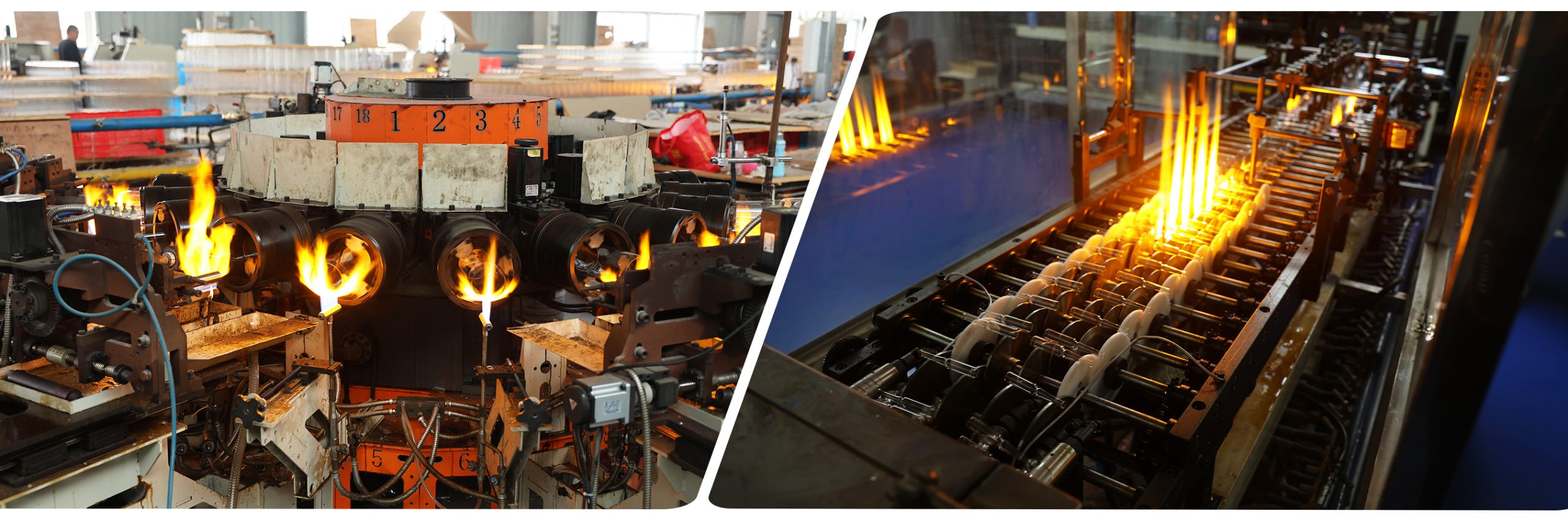
Our production records show that outdoor brands typically request a target empty weight under 500g for a 1000ml bottle—light enough to carry, heavy enough to feel substantial. Achieving that weight without compromising durability requires high-borosilicate 3.3 glass, which has a lower density per volume and higher thermal shock resistance than soda-lime. In our annealing furnace, we run a specific temperature gradient for 1000ml bottles to remove internal stress from the thicker bottom section; skipping this step leads to the hairline base cracks that outdoor users report after temperature swings.
Material Performance: Why Borosilicate Matters for 1000ml Bottles
For brands targeting outdoor and sports markets, the glass material directly impacts return rates. Standard soda-lime glass fails at temperature differences around 40–60°C, whereas high-borosilicate 3.3 glass tolerates fluctuations up to 200°C. This becomes critical when a bottle filled with cold water sits in direct sun on a trail, or when hot tea is poured in at the start of a winter hike.
At Jianmei, we batch-test 1000ml borosilicate water bottles for thermal shock resistance by cycling from -20°C to 120°C within 30 seconds. The test mimics worst-case field use: a cold bottle filled with near-boiling water. Bottles that pass show no micro-cracking at the base or neck. For outdoor brands, this single quality check correlates closely with customer reviews—negative feedback on leaking or cracking is rarely from misuse; it is from material choice and incomplete annealing.
We have also tested bottles with added silicone sleeves for insulation and drop protection. A simple 2mm thick food-grade silicone sleeve, combined with borosilicate glass, reduces breakage from a 1-meter drop by over 60% in our in-house tests, compared to glass alone. For sports brands that sell bottles for gym bags and outdoor packs, this sleeve is not just an accessory—it is a return-rate management tool.
Key Certifications for Export-Ready 1000ml Bottles
International outdoor retailers and sports chains look for a specific certification set before listing a new glass bottle SKU:
| Certification | Relevance for 1000ml Bottles |
|---|---|
| FDA (U.S. food contact) | Required for all food-contact glass sold in the U.S.; confirms no harmful substance migration. |
| LFGB (German Food and Feed Code) | Mandatory for EU retail; stricter than FDA for heavy metal leaching tests. Essential for German-speaking markets. |
| SGS testing (various) | Third-party verification of heavy metal, lead, and cadmium limits—often requested by European sports retailers. |
| CE marking | Confirms compliance with EU safety, health, and environmental standards for food contact materials. |
| BSCI (Business Social Compliance Initiative) | Ethical manufacturing audit; increasingly required by EU and U.S. brands for supplier onboarding. |
Our facility holds FDA, LFGB, CE, and SGS certifications for borosilicate glass bottles, and we completed a BSCI audit in 2025. For brands launching in the EU, we provide LFGB test reports directly—no third-party delay. We keep batch records for every 1000ml bottle run, so if a brand’s customer raises a safety question, the full material trace is available.
Production Consistency at Bulk Volumes for the 1000ml Format
Bottles in the 1000ml range have a larger mold cavity, which means temperature control during forming is less forgiving. In our plant, we use a multi-stage automatic pressing process with 24 molds dedicated to 1000ml water bottles. The machine cycle is calibrated so that each mold receives an identical glass gob weight and pressing force, keeping sidewall thickness within ±0.3mm.
This matters for outdoor brands because uneven wall thickness amplifies thermal stress. A bottle with a 2.5mm wall on one side and 3.0mm on the other will crack at the transition line within a few heat cycles. Our QA team samples 5% of every production batch, measuring thickness at six points per bottle. Batches with deviation exceeding 0.3mm are re-annealed and re-inspected.
Daily output for 1000ml borosilicate bottles runs at approximately 40,000 pieces, enough to fulfill a full-container (40HQ) order within 7–10 days. This speed benefits outdoor brands that plan seasonal launches—Q1 ordering for spring fitness and camping product lines does not miss the shelf date.
Customization Options That Add Value for Sports Brands
Logo and branding
We offer three main marking methods: silk-screen printing, laser engraving, and decal application. For silicone-sleeved 1000ml bottles, laser engraving on the glass shoulder provides a permanent mark that stays visible even when the sleeve covers the body. For sports brands that change colorways seasonally, screen printing on the sleeve itself is faster and allows unlimited color.
Lid and cap configurations
1000ml bottles for outdoor use need leak-proof lids. Our standard options include a stainless steel lid with silicone seal (IPX5 rated), a screw-top plastic lid with carrying loop, and a sports cap with bite valve. We have found that the stainless steel lid is the most requested for premium sports lines—it adds perceived weight and durability, and passes the drop-and-shake test without leaking.
Sleeve materials and design
A 2mm silicone sleeve is standard, but we have developed 3mm EVA foam sleeves for extreme cold use (down to -30°C). These foam sleeves insulate better and absorb shock more effectively. For a Nordic outdoor brand we supplied in 2025, the 3mm sleeve allowed them to market a “cold-temperature bottle” without changing the glass body.
If your program requires a combination of these features, we build a pre-production sample (PPS) that matches the exact BOM. Most PPS work is finished within 15 days, and we encourage brands to test the sample through their own inspection and field-use cycle before approving mass production.
Container Loading and Freight Considerations
A 1000ml glass bottle is a volumetric shipment. With our standard packaging—individual polybag plus 5-layer corrugated master carton—a 40HQ container holds approximately 28,000 units, depending on sleeve thickness and lid size. We provide a load plan before shipment so brands can calculate landed cost per unit accurately.
We also offer mixed-container loading for brands that want to combine 1000ml bottles with 500ml or 750ml sizes in one shipment. The packing team arranges pallet layouts to prevent shifting during transit; we have a zero-tolerance policy on glass-to-glass contact, with dividers between each row in the master carton.
When to Place an Order for Seasonal Outdoor Launches
Outdoor and sports retail follows a predictable calendar: spring camping gear launches in February–March, back-to-school fitness in July–August, winter outdoor gear in October–November. From our factory schedule, the ideal order deadline for a spring outdoor water bottle SKU is November of the prior year. This accounts for 15–25 days sample approval, 30 days mass production (if no custom mold is needed), and 25–35 days ocean freight to the U.S. West Coast or 30–40 days to Europe. Brands that confirm specs by late October avoid holiday period rate increases.
Common Questions About Sourcing 1000ml Glass Water Bottles
What is the minimum order quantity for a custom 1000ml bottle?
Our base MOQ for a new custom 1000ml bottle is 5,000 pieces. If you start with a stock mold and add custom printing and sleeve, the MOQ drops to 2,000 pieces. For the first order, we recommend 5,000 pieces to amortize setup costs.
How do you confirm the bottle is leak-proof?
We test every production batch on a random sample of 100 bottles filled to 80% capacity and inverted for 30 minutes. A batch fails if more than two bottles show leakage, and the full batch is re-inspected. For sports-capped bottles, we also cycle the cap open/close 1,000 times and re-check seal integrity.
Can the 1000ml bottle fit in a standard car cup holder?
Most 1000ml borosilicate bottles have a base diameter of 7.0–8.5 cm. We produce both a narrower 7.5 cm profile and a larger 8.5 cm profile. The 7.5 cm version fits most car cup holders. We ask brands to specify cup holder compatibility if it is a selling point.
Do you provide lab test reports for heavy metal leaching?
Yes. We issue SGS test reports for lead, cadmium, and heavy metal migration for each production lot upon request. The cost is included in the unit price for orders above MOQ.
What happens if a shipment arrives with breakage?
We include breakage insurance up to 3% by adding an extra 100 bottles per every 3,000 ordered. Beyond 3%, we replace at cost. We also pack each bottle in its own position within the master carton, separated by cross-shaped dividers. In the last shipping season, our breakage rate across 40HQ shipments was 0.7% on average.
For brands ready to source 1000ml glass water bottles for outdoor and sports lines, the key is to lock in the material spec, lid, and sleeve details early and test the pre-production sample under field conditions. Send your requirements with target quantity, lid type, and any sleeve customization to [email protected] to confirm capacity and lead time for your production slot.
If you’re interested, check out these related articles:
style function your a w thermflask sourcing guide
all round glassware factory1 direct supply to global buyers