
 English
  Arabic
  Spanish
  German
 Something shifts when you stop reaching for plastic containers and start using glass instead. It’s not just about following a trend—there’s a practical satisfaction in knowing your food storage won’t absorb last night’s curry smell or leach anything questionable into tomorrow’s lunch. The move toward eco-friendly glass kitchenware reflects a broader change in how people think about their kitchens: less disposable, more intentional. Glass has earned its place at the center of this shift because it delivers on promises that other materials struggle to keep.
Why Glass Has Become the Default Choice for Eco-Conscious Kitchens
The market for sustainable kitchen products keeps expanding, and the reasons aren’t hard to trace. Plastic pollution concerns have moved from abstract worry to daily reality for many households. Chemical leaching from containers—especially when heated—has pushed consumers toward materials that don’t carry those risks.
Glass kitchenware offers something straightforward: an inert surface that won’t interact with your food. No BPA concerns, no lead worries, no mysterious additives. The material’s inherent recyclability means it can cycle through production systems indefinitely without degrading in quality. This matters for consumers tracking their environmental footprint across purchasing decisions.
The preference shows up clearly in market data. Glass food storage, drinkware, and bakeware categories are all growing. Manufacturers have responded by expanding product lines and refining designs to match what buyers actually want. The shift toward reusable kitchenware trends isn’t temporary—it reflects a fundamental change in how people evaluate what belongs in their homes.
What Makes Borosilicate Glass the Practical Choice for Daily Use
Borosilicate glass earns its reputation through performance, not marketing. The material’s low thermal expansion coefficient—the technical reason it handles temperature swings—means you can move a container from freezer to oven without the cracking that plagues regular glass. This isn’t a minor convenience; it’s the difference between a product that lasts years and one that fails during normal use.
The heat-resistant glass kitchenware category exists largely because borosilicate solved problems that soda-lime glass couldn’t. Cold-resistant glass containers follow the same logic. When a material can handle the actual conditions of a working kitchen, it becomes genuinely useful rather than decorative.
Beyond thermal performance, borosilicate glass doesn’t absorb odors, stains, or flavors. Store fish one day and berries the next—the container won’t carry memories between uses. This non-toxic kitchen material characteristic makes it practical for meal prep, everyday storage, and serving.
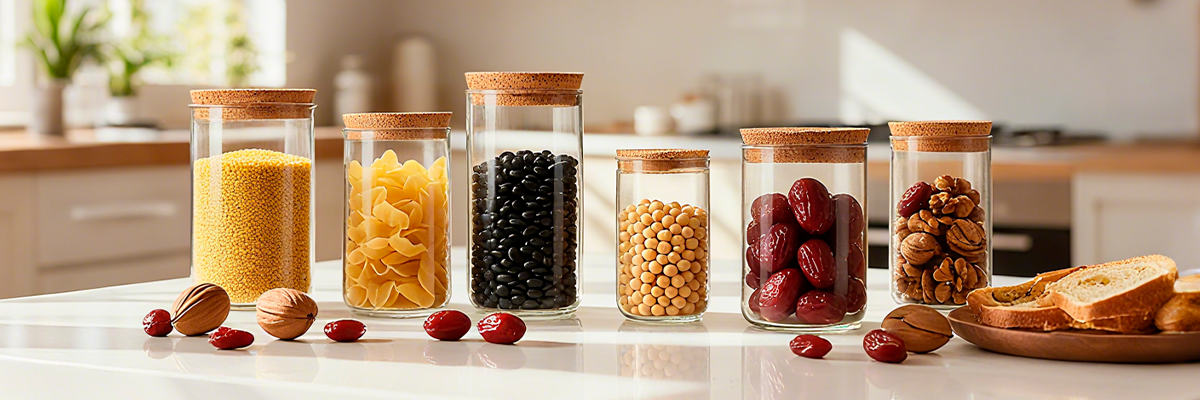
Our manufacturing processes ensure all borosilicate glass products meet food-grade standards. Items like our borosilicate glass Food Storage Jars and borosilicate drink glass water bottle go through testing protocols that verify both safety and durability. The benefits of borosilicate glass extend to aesthetics too—the clarity holds up over time, which matters for products meant to last.
How Borosilicate Glass Differs from Regular Glass in Kitchen Applications
The distinction comes down to chemistry. Borosilicate glass contains boron trioxide, which changes how the material responds to thermal stress. Regular soda-lime glass expands more when heated, creating internal stress that leads to cracking under rapid temperature changes.
This composition difference explains why borosilicate glass transitions safely between freezer and oven while regular glass often shatters. The borosilicate glass composition also produces a less porous surface, improving resistance to chemical corrosion and making the material more hygienic over extended use. These aren’t theoretical advantages—they directly affect kitchen glass durability in daily conditions.
Where the Market is Heading Through 2026
The global glassware market within eco-kitchenware shows consistent upward movement toward 2026. Consumer demand for sustainable and healthy home products continues driving this expansion across regions.
The North America kitchenware market and Europe eco-friendly products sectors lead current adoption rates for glass alternatives. Oceania sustainable kitchenware and South America glass demand are following similar trajectories, suggesting this isn’t a regional phenomenon but a global pattern.
Industry analysis points toward significant investment in sustainable products across multiple categories. Emerging segments include advanced borosilicate glass food storage systems, specialized glass bakeware, and innovative glass beverage containers. Products like our wholesale glass water bottles and borosilicate glass cups with wood lids address these evolving market needs by combining functionality with environmental responsibility.
The market growth eco-kitchenware segment creates real opportunities for manufacturers who can deliver certified, high-quality glass solutions consistently. Meeting this demand requires both production capacity and quality assurance systems that scale.
If you are interested in understanding the broader context of sustainability in the glass industry, check out 《high borosilicate glass innovations driven by europes sustainability surge》.
How Certifications Build Confidence in Glass Products
Quality assurance in global markets depends on verifiable standards. Certifications like FDA certified glassware and CE certified glass products provide the documentation that both manufacturers and consumers need to make informed decisions. These standards verify food-contact safety and specific performance criteria through independent testing.
Our approach to quality control glassware reflects this priority. Xuzhou Jianmei Glass Products Co., Ltd. maintains 120 testing certifications, including FDA and CE, across our borosilicate glass product lines. This certification portfolio demonstrates commitment to product safety standards and supply chain sustainability in measurable terms.
Every item manufactured—from glass jars with bamboo lids to glass water bottle—complies with international regulations. This testing rigor supports partners operating in markets where compliance isn’t optional.
Which Certifications Matter When Evaluating Glass Kitchenware Manufacturers
When assessing eco-friendly glass kitchenware manufacturers, specific certifications indicate quality and safety more reliably than general claims. FDA certification matters for products entering the United States market. CE certification applies to the European Economic Area.
Both attest to compliance with health, safety, and environmental protection standards through documented testing. Additional glassware safety certifications like LFGB or SGS demonstrate manufacturer compliance with international quality standards and robust testing protocols. These certifications represent actual verification, not self-reported claims.
Customization Options That Match Real Business Needs
Market demands vary, and eco-friendly kitchenware buyers often need more than standard catalog options. Custom glass kitchenware and OEM glass manufacturing services allow brands to differentiate their offerings in meaningful ways.
We provide tailored solutions covering glass body, shape, capacity, and opening diameters for products including glass jars wholesale and glass water bottles suppliers. Customization extends to logos and packaging, supporting brand consistency across product lines.
Our product innovation glass capabilities draw on 45 appearance patents and 32 IP rights. Minimum order quantities start from just 1 piece, making high-quality customized borosilicate glass products accessible to businesses at different scales. This flexibility applies to glass cups bulk orders and glass tea tumblers alike. ODM/OEM services translate specific product visions into manufactured reality.
Production Capacity That Supports Long-Term Partnerships
Reliable supply depends on manufacturing infrastructure that matches stated capabilities. Xuzhou Jianmei Glass Products Co., Ltd. operates a 40,000 sq.m facility equipped with 100 advanced machines. Our 200-employee team produces 200,000 pieces daily, providing consistent global market supply for both standard and custom orders.
Sustainable business practices guide operations from raw material sourcing through final delivery. Our focus on heat/cold-resistant borosilicate glass products aligns with growing demand for durable, reusable items that perform over years of use.
Partnering with a reliable glass supplier means access to high-quality, eco-friendly solutions without supply chain uncertainty. We support client growth while contributing to reduced environmental impact through products designed for longevity.
Partner with Xuzhou Jianmei Glass Products
As demand for eco-friendly kitchenware continues growing toward 2026, working with an experienced and certified manufacturer reduces risk and improves outcomes. Xuzhou Jianmei Glass Products Co., Ltd. brings expertise in borosilicate glass production backed by 45 appearance patents, 32 IP rights, and 120 testing certifications.
Our 40,000 sq.m facility and daily production capacity of 200,000 pieces support custom, OEM, and bulk orders with consistent quality. Contact us at [email protected] to discuss how our sustainable glass solutions can strengthen your product line.
Frequently Asked Questions About Eco-Friendly Glass Kitchenware
What makes glass kitchenware a sustainable choice compared to other materials?
Glass kitchenware, particularly borosilicate glass, offers sustainability through several practical characteristics. The material doesn’t leach chemicals into food, can be reused indefinitely without degradation, and is made from abundant natural resources. Its long lifespan reduces replacement frequency and waste generation. These factors make it a genuinely eco-conscious choice for consumers evaluating sustainable kitchen products.
How does Xuzhou Jianmei Glass Products ensure the quality of its borosilicate glass kitchenware?
Quality assurance at Xuzhou Jianmei Glass Products Co., Ltd. combines manufacturing controls with third-party verification. Our 100 advanced machines and 200-employee team follow documented processes. Products undergo testing that results in 120 certifications including FDA and CE, confirming compliance with global safety and performance standards for heat/cold-resistant borosilicate glass kitchenware.
Can Xuzhou Jianmei Glass Products accommodate custom designs and OEM orders for glass kitchenware?
Yes. Custom orders and OEM services represent a core capability. With 45 appearance patents and 32 IP rights, we have documented experience developing unique designs and manufacturing products to specific client requirements. Minimum order quantities start from just 1000 piece, supporting businesses at various scales seeking customized glass jars, water bottles, and cups.