
 English
  Arabic
  Spanish
  German
 Glass water bottles with fruit infuser represent a growing product category for health and wellness brands, but sourcing them reliably means verifying material grade, leak-proof design, and manufacturing certifications because substandard glass can damage the trust you’ve built with health-conscious customers. In the ten years I’ve spent overseeing high borosilicate glass production lines, I’ve seen brands lose months of development time because a supplier shipped bottles that looked right but cracked under temperature change or leaked after the first use. The difference between a product that strengthens your brand and one that generates returns comes down to a handful of technical decisions made before the first bottle is molded. This article addresses the manufacturing and sourcing specifications that health and wellness brands must verify before placing a bulk order, covering material selection, leak-proof design, customization, and certification requirements that procurement managers encounter but rarely find documented in one place.
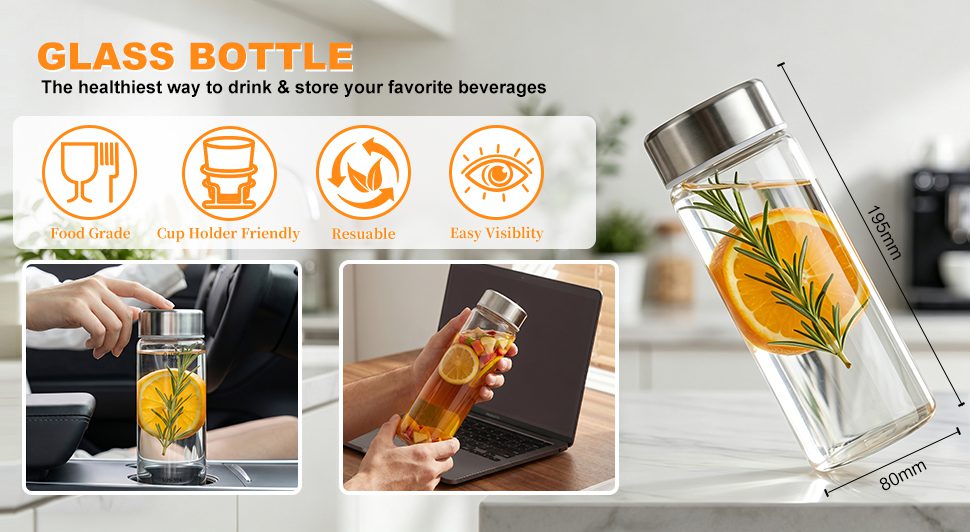
Why Material Grade Matters for Glass Water Bottles with Fruit Infuser
Health brands sell more than hydration—they sell purity, safety, and the idea that what the customer puts into their body matters. If the bottle that holds that fruit-infused water carries even a hint of chemical leaching or unexpected glass shatter, the brand promise breaks. The most important material decision you can make as a buyer is to specify 3.3 borosilicate glass rather than standard soda-lime glass. Soda-lime is cheaper, but its thermal shock resistance is poor; pour hot water into a chilled soda-lime bottle and you can expect fractures. Borosilicate glass, by contrast, handles a range from -20°C to 300°C without structural failure. At our facility we never run fruit infuser bottles on soda-lime tooling because the warranty claims aren’t worth it.
Beyond thermal performance, pay attention to the glass composition itself. Lead and cadmium traces sometimes appear in low-cost glass sourced from uncertified raw material suppliers. This is a non-negotiable for health brands: your bottles must be BPA-free, lead-free, and food-grade. Request third-party lab reports—not just a factory declaration—that show compliance with FDA, LFGB, or equivalent standards in your target market.
What Certifications Ensure a Glass Water Bottle Is Safe?
A supplier who says “our glass is food-safe” without documentation hasn’t given you anything you can show your retailer or your customer. Health and wellness brands need to front-load certification verification during the screening stage. The baseline is FDA and LFGB. FDA tests cover specific migration limits for food-contact materials in the United States, including lead and cadmium. LFGB, the German standard, is stricter on sensory testing and is often required by European retailers. If you’ll sell online through Amazon, you may also need lab reports that satisfy their compliance team.
Our facility maintains 120 active testing certifications covering finished products and raw materials, and we re-test each production batch on a sampling schedule before release. When you request a sample, ask for the corresponding batch test report. If the supplier hesitates or provides a report dated more than a year ago, treat that as a red flag. Compliance paperwork isn’t a one-time event; it’s an ongoing production discipline.
Customization Options to Differentiate Your Wellness Brand
A plain glass bottle with a generic fruit infuser insert will blend into the search results. Health brands need to own their aesthetic, and that starts with the product itself. The two customization levers that matter most are mold design and surface decoration.
OEM mold development lets you create exclusive shapes—maybe a slim profile for yoga studio shelves or a wide-mouth design that makes slicing fruit directly into the chamber practical. Mold customization typically requires a one-time fee and a moderate minimum order commitment, but it locks your SKU as uniquely yours. If a dedicated mold isn’t in the budget right away, ODM options exist: you can select from existing mold libraries and differentiate through logo printing and packaging. Silk-screen printing, laser engraving, and decal application each have different durability profiles. If your bottle has a silicone sleeve, printing on the sleeve instead of the glass can simplify the production workflow. We recommend matching the decoration method to the expected use environment—laser engraving holds up better under repeated dishwasher cycles, while silk-screen can offer more color options at a lower per-unit cost.
If your program involves a specific fruit infuser basket dimension or a leak-proof warranty, it is worth confirming mold details and seal material before finalizing your BOM, reach out at [email protected].
How to Check a Glass Water Bottle Manufacturer’s Quality
When I walk through a glass factory, three things tell me the real story faster than any slide deck: the annealing line, the quality control station layout, and the daily production records. For a fruit infuser bottle, production quality isn’t just about the glass body—it’s about the assembly. The infuser insert must mate with the lid, the lid must seal against the bottle rim, and all three components must survive thermal cycling without warping or hairline cracks.
| Quality Checkpoint | What to Verify | Why It Matters |
|---|---|---|
| Annealing process | Furnace temperature logs for each batch | Proper annealing removes internal stress; bottles that skip this step explode under temperature change |
| Dimensional tolerance | Neck diameter and thread pitch of bottle and lid | Even 0.2mm mismatch causes leaks or cross-threading |
| Seal material | Food-grade silicone with migration test reports | Low-quality silicone imparts taste and fails LFGB |
| Assembly test | Random sampling for leak test at high and low temperature | Real-world use exposes batch defects that visual inspection misses |
A factory running 100 automated machines on a 40,000-square-meter floor, like ours, can produce 200,000 pieces daily. That scale is only meaningful if the quality system scales with it. Ask the supplier: what percentage of each batch goes through pre-shipment inspection? Who performs the inspection—an internal team or a third-party agency? I’ve found that a dedicated in-line QC team catching defects at each production node prevents far more returns than end-of-line sampling alone.
Placing Your First Order: MOQ, Lead Times, and Logistics
Smaller health and wellness brands often assume they can’t order custom glass because the minimum order quantity is too high. That assumption costs them months of unnecessary delay. Many borosilicate glass manufacturers, including our company, now support low-MOQ orders—sometimes as low as one piece for sampling—to help brands test the market before committing to container quantities. The key is to understand the cost breakpoints: a 500-piece trial order will carry a higher per-unit price than a 5,000-piece production run, but the unit economics still work if your retail price point supports it.
Sample timelines vary by complexity. A standard fruit infuser bottle selected from existing molds can ship within 7–10 days of order confirmation. A fully custom mold adds 25–35 days for mold fabrication and trial sampling. Budget accordingly so you don’t miss your seasonal launch window. Factor packaging into the timeline as well: custom boxes or inserts add another 10–15 days of production and require separate artwork approval. Shipping from our Jiangsu facility to major ports in North America or Europe typically runs 25–35 days by sea; air freight is available but rarely cost-effective for glass at less than full-container volume.
Common Sourcing Questions for Glass Water Bottles with Fruit Infuser
Are glass water bottles with fruit infusers safe for both hot and cold drinks?
Yes, if they are made from 3.3 borosilicate glass. This material withstands rapid temperature swings from -20°C up to 300°C, so hot tea and ice-chilled fruit water are equally viable. In contrast, soda-lime glass fruit infuser bottles frequently crack when exposed to temperature shock. Always verify that the supplier explicitly uses borosilicate, not “high-strength” soda-lime marketed as heat-resistant.
How do I prevent leaks in a fruit infuser bottle?
Leaks usually originate at the seal between the lid and the bottle rim, or around the infuser basket insert. The most reliable design uses a food-grade silicone gasket compressed by a stainless steel or plastic lid with a consistent thread pattern. Demand a leak test report for the assembled product under both ambient and cold conditions. If your supplier cannot provide one, run your own test on pre-production samples by filling the bottle, inverting it, and leaving it overnight.
Can I get a custom fruit infuser shape exclusive to my brand?
With an OEM mold, yes. The mold development cost varies based on complexity, but once you own the mold, no other brand receives bottles from that tooling. This is the strongest form of product protection. For brands with smaller budgets, semi-custom options like custom logo printing and unique silicone sleeve colors on an open mold still create a differentiated look without the upfront tooling investment.
What happens if my shipment arrives with broken bottles?
Glass breakage during shipping is almost always a packaging failure, not a manufacturing defect. The solution is to specify individual box partitions, bubble wrap or foam cushioning, and a double-wall master carton. We also recommend a pre-shipment drop-test report conducted to ISTA standards. If breakage still occurs, a reputable supplier will offer compensation or replacement on your next order. Clarify these terms in the purchase agreement before production begins.
How do I ensure the glass won’t affect the taste of infused water?
Borosilicate glass is chemically inert and does not leach or absorb flavors. The more common taste issue comes from low-grade silicone seals or plastic lids that off-gas. Ask your supplier for migration test reports on every material that contacts the water, not just the glass body. Share your target market’s specific requirements and we’ll confirm compliance documentation availability at [email protected].
If you’re interested, check out these related articles:
style function your a w thermflask sourcing guide
five key points for year round promotions
the ultimate guide daily actions to protect the earth