 English
  Arabic
  Spanish
  German
 Retailers stocking glass jars for food storage face a sourcing decision that goes beyond unit price. The glass formula, lid seal design, and factory quality controls directly determine whether those jars reach consumers intact and perform as expected. Wholesale glass jars for food storage are a high-turnover product category, but inconsistent material quality or weak seals can generate returns that erase margins. This guide covers the manufacturing variables that matter for retail success, drawing on over a decade of production experience with high borosilicate glassware.
Why High Borosilicate Glass Outperforms for Food Storage
A food storage jar lives on a countertop, in a refrigerator, and sometimes in a customer’s dishwasher. Not all glass handles that range of conditions well. The material choice determines thermal shock resistance, chemical stability, and long-term clarity.
Soda-lime glass, the most common low-cost option, can develop micro-fractures when moved from freezer to room temperature. Those fractures weaken the wall and increase breakage risk. High borosilicate glass contains boron trioxide, which reduces the coefficient of thermal expansion to about 3.3×10⁻⁶ K⁻¹, roughly one-third that of soda-lime. In practice, a borosilicate jar goes from the refrigerator to a hot water bath without cracking, a performance difference that directly reduces retailer return rates.
s)
From a production standpoint, I have seen order samples arrive with wall thickness variations that looked acceptable to the naked eye but failed thermal shock testing. A jar with 2.2mm wall thickness in one spot and 1.7mm in another cannot distribute stress evenly. That unevenness matters because brands selling into health-conscious markets often position these jars as meal-prep solutions, where daily temperature cycling is normal. Consumers expect the jar to survive as well on day 90 as it does on day one.
Another factor retailers sometimes overlook is chemical durability. High borosilicate glass resists leaching even when holding acidic foods like citrus-based dressings or tomato sauces over extended storage. That matters for food safety compliance and for maintaining consumer trust.
Food Safety Certifications That Glass Jars Must Have
Food contact products entering North American and European markets require proof of safety, not just supplier claims. The certifications a manufacturer holds indicate whether their production line has been independently verified for heavy metal migration, thermal performance, and overall material safety.
For glass jars, the most frequently requested credentials are FDA 21 CFR 175.300 for the U.S. market and LFGB (German Food, Commodity and Feed Code) for European Union buyers. Both test for lead, cadmium, and other heavy metals that can leach from glass or decorative coatings. A factory that can show current test reports for each production batch gives the importer documentation to satisfy customs and retail partner audits.
In our facility, third-party testing covers every production run. We maintain FDA, LFGB, and CE certifications, and we can supply batch-specific reports upon request. That documentation becomes part of your due diligence file, which major supermarket chains require before listing a new supplier.
| Certification | Market | Key Test Parameters |
|---|---|---|
| FDA 21 CFR 175.300 | United States | Lead, cadmium, total migration |
| LFGB Sections 30, 31 | European Union | Heavy metal release, sensory neutrality |
| CE (Regulation 1935/2004) | EU | Overall migration, specific substance migration |
If your retail channels span multiple regions, verify that the manufacturer can test to all applicable standards. Running separate certifications costs more up front but prevents a shipment from being quarantined at the destination port, which costs far more in lost seasonality and storage fees.
Matching Jar Specifications to Your Food Category
A jar that works for coffee beans does not work for honey. The neck diameter, seal material, and capacity all affect whether the container performs for a given application. Matching specifications to the food category before freezing a design reduces customer complaints later.
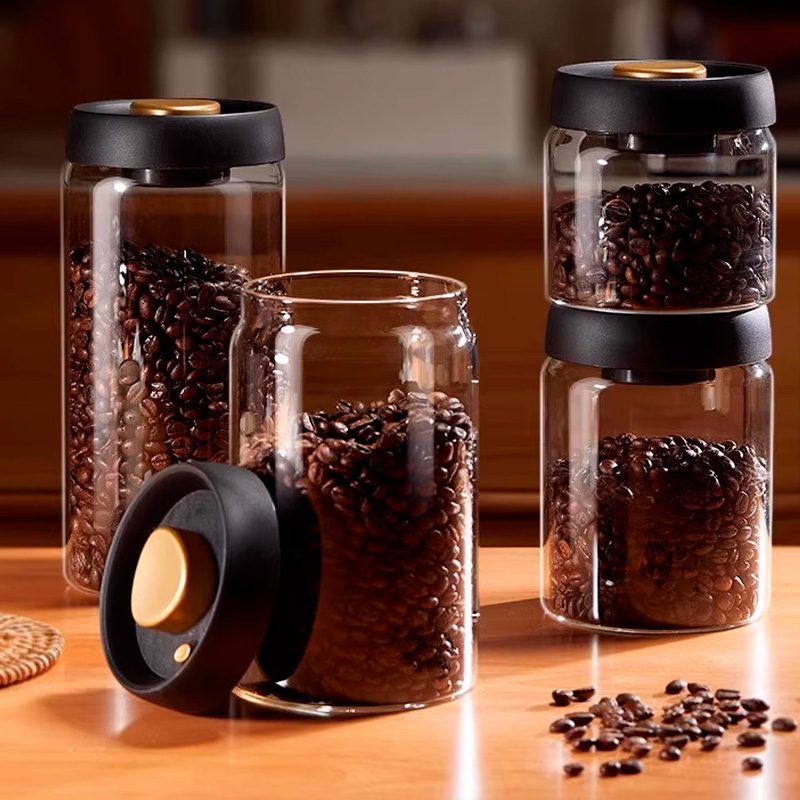
For dry goods like coffee, tea, and spices, a medium neck diameter of 50-65mm allows a scoop or spoon to enter without spilling. The seal needs to block oxygen transmission, so we recommend a stainless steel or wood lid with a high-density silicone gasket. A 750ml or 1000ml capacity suits most pantry shelves.
For liquid or semi-solid foods like honey, jam, and dressings, the lid and seal face must withstand repeated opening without losing torque. A smooth glass rim without micro-chipping is essential for a consistent seal. I’ve observed that jars with a slight bevel on the rim seat—added during the annealing stage—maintain seal integrity over more cycles than flat-cut rims.
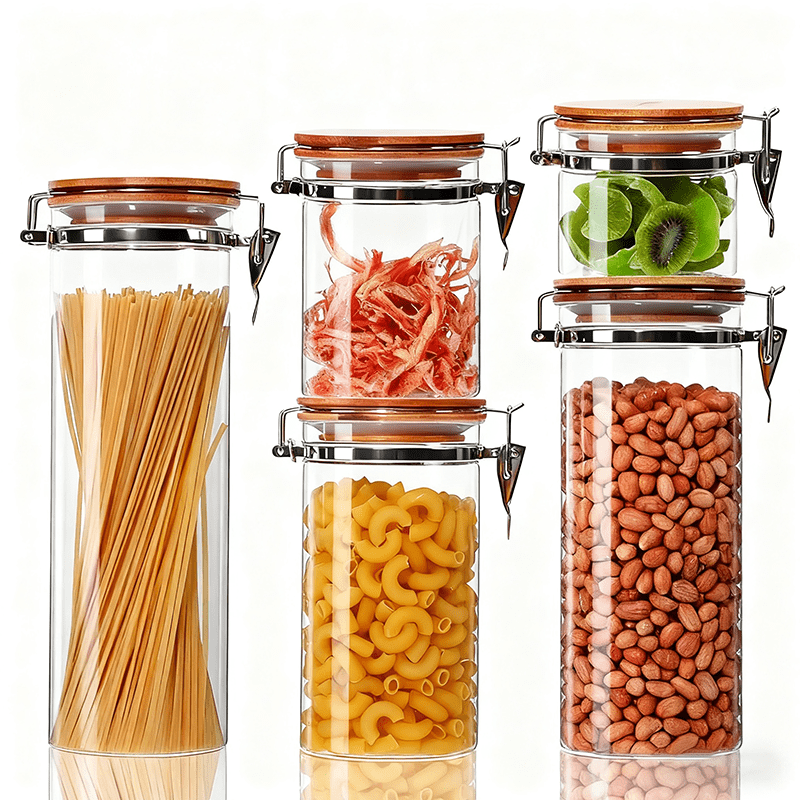
A common decision point for retailers is whether to stock a single large jar or a multi-size set. My data from production runs shows that a set of three capacities (e.g., 500ml, 750ml, 1000ml) with the same lid diameter allows inventory consolidation, because lids and gaskets become interchangeable across SKUs.
If your program involves multiple food categories with different viscosity and storage needs, the seal specification becomes a decision you cannot make from a catalog. Our engineering team reviews seal compatibility and can confirm which lid and gasket combination performs for your specific product. Reach out directly at [email protected] to discuss the specifications.
How to Evaluate a Glass Jar Manufacturer Beyond the Price Quote
Price per unit gets attention, but three less obvious factors determine whether a sourcing relationship delivers consistent quality over multiple order cycles: production equipment, in-house annealing capability, and mold development process.
First, production equipment. A facility running 100 automated molding machines, as we do, distributes production volume across parallel lines. If one line goes down for maintenance, others continue output. This redundancy matters for retailers with seasonal restock deadlines. A plant with only a handful of machines cannot absorb disruptions the same way.
Second, annealing process. After forming, glass jars pass through an annealing lehr where the temperature is gradually reduced to relieve internal stress. A poorly controlled annealing cycle leaves residual stress in the wall, which can cause delayed fracture weeks after shipment. Our annealing lehrs operate with ±2°C temperature control across a 5-meter zone, and we sample-test for stress birefringence from every lehr batch.
Third, mold development. When a retailer requests a custom shape or embossed logo, the mold cost and lead time depend on whether the factory cuts molds in-house or outsources. In-house mold fabrication shortens the timeline from design approval to sample by two to three weeks and allows faster revisions if the first sample needs adjustment.
Quality Control from Sample Approval to Export Shipment
The period between sample approval and container loading is where most sourcing problems arise. Batch-to-batch variation in dimension, clarity, and lid fit can appear if the quality control system relies only on final product sampling rather than in-process checks.
We run a three-stage QC protocol that catches outliers before they become shipments. Stage one is in-process: after forming, jars are visually scanned for bubbles, cords, and dimensional deviation against the mold specification. Stage two is post-annealing: samples from each lehr cycle undergo thermal shock testing by quenching from 120°C to 20°C water. Any batch that fails triggers a line stop and root-cause review. Stage three is pre-packing: random samples from the finished batch are checked for lid fit, verticality, and floor contact to ensure stable stacking in retail display.
For imports involving custom packaging, we also conduct a carton drop test at 1.2 meters per ISTA 3A protocols. The pass rate we expect for a properly padded inner tray is 99.5% or higher. If a retailer’s receiving warehouse reports breakage above this threshold, the root cause is usually insufficient internal cushioning, not the glass itself. That is why we offer custom packaging inserts designed to work with our jars’ specific dimensions and weight.
A sourcing program that skips these QC steps may succeed on the first shipment but will encounter a quality-related problem by the third order, as production volumes increase and process control drifts. I have worked with buyers who initially chose a lower-priced factory only to return to us after experiencing exactly that drift. Consistent quality is a production discipline, not a one-time check.
If you are sourcing glass jars for food storage and need a manufacturer that can deliver consistent quality, complete food safety certifications, and flexible customization without quality drift, contact us at [email protected]. We can review your specifications, confirm the appropriate material and seal combination, and provide sample jars that reflect production-line output, not just a hand-picked prototype.
Common Questions About Sourcing Glass Food Storage Jars
What is the minimum order quantity for custom glass jars?
It depends on the jar’s complexity and whether a new mold is required. For a standard jar shape using an existing mold, we support orders starting at 1000 pieces per SKU. For a custom mold design, the mold investment usually requires a 5000-piece minimum to amortize tooling costs. Smaller quantities are possible for sampling and market testing, but the per-unit cost increases. We often advise new retailers to start with a stock shape in two capacities, test market response, and invest in custom tooling after validating the category sells.
Can I get a sample before placing a bulk order?
Yes, we provide pre-production samples from the actual production line, not a separate sample workshop. This ensures the sample reflects the same glass composition, annealing schedule, and machine output you will receive in bulk. We typically ship 3-5 samples of each SKU within 7-10 business days after specification confirmation. The sample cost is deducted from your first purchase order if you proceed.
How are glass jars packed to prevent breakage during shipping?
We pack jars using five-layer corrugated cartons with die-cut internal dividers that isolate each jar. For long-distance sea freight, we add a 2mm EPE foam wrap around each jar and use a 1.5-meter drop-test standard to validate carton integrity. Palletizing uses stretch wrap and corner protectors. Breakage rates for export shipments average below 0.5% when this packing method is followed. If your distribution center has specific pallet height requirements, we can adjust the carton dimensions to match.
What is the lead time for a custom jar production run?
A standard production run using existing molds typically ships in 25-30 days after order confirmation. A custom jar requiring new mold fabrication adds 15-20 days for mold creation and sampling. The holiday season (August through October) extends lead times by about two weeks due to high demand. If you are planning a seasonal retail launch, I recommend sharing your timeline early so we can confirm whether the current production schedule fits your go-to-market date. Send your launch plan and specifications to [email protected], and we can provide a realistic timeline assessment within 48 hours.
If you’re interested, check out these related articles:
how to distinguish sodalime glass from borosilicate glass
all round glassware factory1 direct supply to global buyers
whats the difference between glass jars and glass bottles
the best materials for drinkware glass ceramic or stainless steel