 Arabic
  English
  Spanish
  German
 Most buyers evaluating logo printing on glassware focus on how the finished product looks on a retail shelf. The real question, from a production perspective, is how that logo holds up after six months of daily use, commercial dishwashing, and handling. Three methods dominate glassware decoration—silk screen printing, laser engraving, and decal application—but the right choice for your product line depends on the glass substrate, your order volume, and where the product will actually be used. I see importers make expensive mistakes here by choosing a method based on appearance alone, without understanding how the decoration interacts with borosilicate glass specifically.
What Separates Silk Screen, Laser, and Decal on Glass Products
Each method produces a fundamentally different bond between the decoration and the glass surface. Understanding this bond determines whether your logo survives or fails under real use conditions.
Silk screen printing applies ceramic ink through a mesh stencil directly onto the glass surface, followed by high-temperature firing that fuses the ink into the glass. The result is a decoration that becomes part of the glass itself. On borosilicate substrates, the firing temperature must be calibrated carefully because the thermal expansion coefficient differs from soda-lime glass. If the furnace profile is not adjusted for borosilicate, the ink can craze or delaminate within weeks. Our annealing furnaces run separate profiles for borosilicate versus standard glass for exactly this reason.
Laser engraving removes a microscopic layer of the glass surface using a focused beam, creating a frosted, permanent mark. The mark is the glass—there is no added material to wear away. On clear borosilicate glass, the contrast can be subtle, which matters if your branding relies on high visibility. The depth and visibility of the engraving depend on the laser wavelength and the glass composition. Borosilicate requires higher laser power than soda-lime to achieve the same visual density because of its higher silica content.
Decal application transfers a pre-printed design onto the glass using a waterslide or heat-release carrier, followed by a lower-temperature firing or curing cycle. The decal sits on top of the glass rather than fusing into it. This is the most flexible method for multi-color designs, but the bond is the weakest of the three. Decals on borosilicate glass that will face thermal cycling—hot coffee to cold rinse—can develop edge lifting within months if the adhesive system is not matched to borosilicate’s thermal expansion rate.
| الطريقة | Bond Type | Firing Required | الأفضل لـ |
|---|---|---|---|
| Silk Screen | Fused into glass | Yes, 550–600°C | Single-color logos, high volume |
| Laser Engraving | Surface removal | لا يوجد | Permanent marks, premium look |
| Decal | Surface adhesion | Low-temp cure | Multi-color designs, low volume |
How Production Volume and Glass Type Shape the Real Cost of Logo Methods
Silk screen printing carries a high setup cost that drops sharply with volume. The screen itself is a fixed cost, and the setup time on the printing line is the same whether you run 500 or 50,000 pieces. For orders above 5,000 units, silk screen is typically the lowest per-unit cost. Below that threshold, the setup cost dominates, and a buyer should compare per-unit costs including amortized setup.
Laser engraving costs scale almost linearly with volume. There is no screen to produce and no ink to manage, but each piece requires individual cycle time under the laser head. For 500 units, laser engraving can be cheaper than silk screen because there is no upfront tooling. For 50,000 units, the cycle time becomes the bottleneck. A production run of 50,000 borosilicate bottles with laser engraving will take significantly longer than the same run with silk screen, and that time difference translates directly into cost.
Decal costs scale moderately. The decal itself is printed on transfer paper, which has a moderate setup cost per design, and application labor is the dominant cost driver. Decals work well in the 1,000 to 10,000 unit range where silk screen setup is not yet fully amortized and laser cycle time is becoming expensive.
The glass type matters here more than most sourcing guides acknowledge. Borosilicate glass requires higher firing temperatures for silk screen inks, which increases energy cost and extends furnace time versus soda-lime. Laser engraving borosilicate requires higher power settings and slower pass speeds, increasing cycle time. Decals on borosilicate need adhesive systems rated for the full -20°C to 300°C thermal range that borosilicate products experience, which is a narrower supplier base than standard decal adhesives.
If your order volume sits between 500 and 3,000 units and the product is borosilicate glassware, laser engraving often lands as the most cost-effective option once you account for the borosilicate-specific adjustments that drive up silk screen and decal costs. This is a pattern I see consistently across production runs for export buyers.
Where Each Method Fails First and What That Means for Your Brand
Durability failures follow predictable patterns for each method, and knowing where to expect them can save your brand from a costly batch.
Silk screen prints fail at the edges first. If the firing profile was off or the ink did not fully fuse, the edges of the printed area begin to chip under abrasion. This is often invisible on arrival but appears within the first month of use. Food-safe glassware faces an additional requirement: the ink must not leach anything into the contents. Our silk screen inks are certified lead-free and food-grade, and we run batch tests on fired samples before shipping. If your supplier cannot provide lead-leaching test results specific to the decorated product, you should request them before approving a production run.
Laser engraving failures are rarer but harder to fix. If the laser power is set too high, especially on thinner borosilicate walls, the glass can develop micro-cracks around the engraved area that propagate over time. This is more common on bottles and cups with wall thickness under 2mm. A properly calibrated laser on thick borosilicate glassware produces a mark that is effectively indestructible—it will outlast the product itself. The trade-off is lower visual contrast on clear glass.
Decal failures are the most common I see in returns. The decal peels at the edges, especially around curved surfaces, or the entire design lifts off after repeated dishwasher cycles. The best defense is a decal adhesive system rated for thermal cycling and a sealant overcoat, but this adds cost and step time. If your product is a borosilicate water bottle that will go through a dishwasher 300 times a year, laser engraving is the safer choice for the logo.
Understanding Dishwasher Tolerance for Decorated Glassware
Commercial and residential dishwashers attack glass decoration differently, and not all methods survive equally.
Silk screen printed logos, when properly fired, withstand dishwasher cycles well because the ceramic ink is fused into the glass matrix. The weak point is not the ink itself but the interface between the ink and any overglaze or protective coating applied after firing. I recommend buyers specify that no post-fire coating be applied unless the product will see abrasive cleaning. The bare ceramic ink surface is harder than most coatings and more chemically inert.
Laser engraved marks are unaffected by dishwashers. There is nothing to dissolve, lift, or abrade. This is the only method where I can confidently say the logo will be as visible after 1,000 cycles as it was on day one. For restaurant chains, hotel procurement, and any B2B buyer where glassware runs through high-temperature commercial dishwashers daily, laser engraving is the lowest-risk choice.
Decals are the most variable. A well-applied decal with a thermal-rated adhesive and a sealant overcoat can survive 200–300 residential dishwasher cycles. Without the sealant, edge lifting typically starts within 50 cycles. Commercial dishwashers with higher temperatures and stronger detergents accelerate this significantly. If your customer is a café or restaurant, avoid decals for the main logo on frequently washed items. For decorative elements that do not carry brand identity, decals remain viable.
Color Options Across Decoration Methods on Borosilicate Glass
Color flexibility is where the methods diverge most dramatically, and this often drives the final decision for brands that need specific Pantone matches.
Silk screen printing on glass supports a wide color gamut, including precise Pantone matching. Each color requires a separate screen and a separate pass through the printing and firing process. On borosilicate glass, multi-color silk screen jobs require careful registration because the glass expands slightly differently during each firing cycle than soda-lime would. Two-color designs are routine; four-color designs are expensive and carry higher rejection rates.
Laser engraving produces only one color: the frosted white of ablated glass. On clear borosilicate, this creates a subtle, premium look that pairs well with minimalist branding. On colored or coated glass, the laser can remove the coating to expose the clear glass underneath, creating a two-tone effect. But there is no way to add a specific brand color through laser engraving alone.
Decals offer the widest color range and can reproduce complex multi-color artwork, gradients, and photographic images. This is why decals remain the standard for high-detail promotional glassware and gift sets, even though the durability is lower. For a corporate gift set that will be used occasionally and hand-washed, a multi-color decal produces the richest visual result. For a daily-use water bottle, the trade-off between color and durability should lean toward durability.
For borosilicate products in particular, I advise buyers to test the finished sample through 50 dishwasher cycles before committing to a production run, regardless of the decoration method chosen. The interaction between borosilicate’s thermal behavior and the decoration material is not theoretical—it shows up in testing, and it is better to catch edge lifting or color shift on a sample than in a container of 10,000 units.
Common Questions About Logo Application on Glass Products
Is laser engraving visible enough on clear glass for branding to work?
It depends on the viewing distance and lighting. Up close, a laser engraved logo on clear borosilicate glass has a frosted, etched appearance that reads as premium and understated. At arm’s length in typical retail lighting, the contrast can be low. For shelf appeal, some brands combine laser engraving with a colored silicone sleeve or a printed label on the packaging to carry the color branding, while the glass itself holds a permanent, subtle mark. For hospitality use where the logo needs to be visible across a table, silk screen is typically the better choice.
Can I mix decoration methods on one product?
Yes, and this is more common than most buyers realize. A borosilicate water bottle might use laser engraving for the primary logo that must never wear off, plus a small decal for a decorative element, or silk screen for a measurement scale on the side. The production line sequences the methods so that any firing steps happen before adhesive-based steps. If you are planning a mixed-method design, confirm with your manufacturer that they have experience running this sequence on borosilicate glass specifically—the firing schedule for the silk screen step must complete before decal application begins, and the total thermal exposure must not exceed what the decal adhesive can tolerate during the cure cycle.
Which method handles curved glass surfaces best?
Silk screen printing handles gentle curves well because the screen flexes to maintain contact. Laser engraving works on curved surfaces as long as the laser head can maintain focus distance, which is manageable on cylindrical shapes like bottles and cups but becomes difficult on compound curves. Decals are the most adaptable to complex curves, which is why they are common on irregularly shaped promotional glassware. On a standard cylindrical borosilicate bottle, all three methods work. On a gourd-shaped beer mug with multiple radius changes, decals or silk screen will produce better results than laser.
Does the glass thickness matter for laser engraving?
Yes, and this is where production experience matters. Borosilicate glass bottles and cups typically have wall thickness between 1.8mm and 3mm depending on the product design. On walls thinner than 2mm, laser engraving can create stress concentrations that lead to breakage during thermal cycling. A production team that runs borosilicate glass daily adjusts the laser power and pass speed based on the wall thickness at the engraving location. If the product has a variable wall thickness, the engraving should be positioned on the thicker section. This is the kind of detail a general decoration vendor may miss, but an experienced borosilicate glass manufacturer accounts for in the quoting stage.
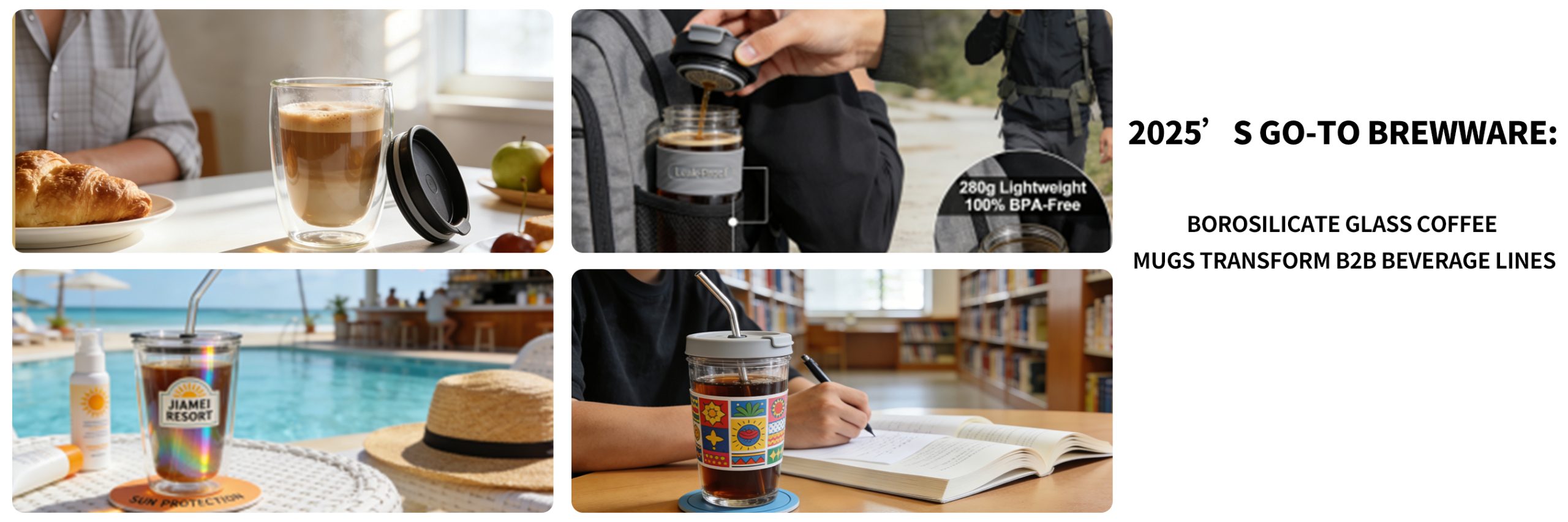
The choice of logo printing method on glassware is not just about appearance. On borosilicate glass products that will be used daily, washed repeatedly, and possibly shipped internationally, the decoration must survive everything the glass itself survives. If your product line includes borosilicate drinkware with wall thickness under 2mm or products destined for commercial dishwasher environments, laser engraving is the most durable option. For high-volume, single-color branding on thicker-walled glassware, properly fired silk screen printing delivers decades of wear at the lowest per-unit cost. If your program involves multi-color designs, curved surfaces, or lot sizes between 1,000 and 10,000 units, it is worth confirming the specific decal adhesive system your manufacturer plans to use before finalizing your order. Share your product specifications, volume, and end-use conditions and we can recommend the decoration method that matches your requirements. Reach us at [email protected].
إذا كنت مهتماً، اطلع على هذه المقالات ذات الصلة:
استدامة المذاق لماذا تختار الزجاج
أطلق العنان لإمكانات علامتك التجارية مع الطباعة بالأشعة فوق البنفسجية
زجاجات مياه رياضية فاخرة مزودة بأغطية واقية