 Arabic
  English
  Spanish
  German
 School brand buyers often assume that a supplier’s FDA or LFGB certificate guarantees kid-safe زجاجة ماء زجاجيةs. In production reality, what separates a bottle that survives a child’s school day from one that cracks or leaches is not the certificate on the wall but the annealing curve, the visual inspection threshold, and whether the factory treats children’s products as a distinct production category. I have seen batches where the same borosilicate tubing produced bottles that passed thermal shock testing and bottles that failed because the annealing furnace temperature drifted by twelve degrees over a shift. For school brands, that variance is the difference between a product parents trust and a recall. Sourcing 400ml زجاجة ماء زجاجية من البورسليكاتs for school programs means verifying the controls behind the certifications, and that starts with understanding what the factory floor actually does differently when the end user is eight years old.
Kid-Safe Glass: What Manufacturing Standards Actually Matter
Most sourcing conversations about children’s glass drinkware start with material composition. Borosilicate glass, specifically 3.3 expansion borosilicate, is the correct starting point. Its low coefficient of thermal expansion means a bottle filled with ice water at 7 a.m. does not crack when a child rinses it under warm water after lunch. That property is inherent to the material, but it only delivers kid-safe performance when the forming and annealing processes are correct.
In our production facility, children’s water bottle orders run on dedicated mold lines with narrower parameter windows than general drinkware. The gob temperature at the feeder, the mold cooling rate, and the annealing lehr belt speed are all tightened. For a 400ml bottle, the wall thickness distribution matters more than on a 500ml adult bottle because the smaller diameter can create uneven cooling if the mold design is not optimized. We measure wall thickness at six points per bottle during first-article inspection and at four points during production sampling. A bottle with a thin spot near the base will pass visual inspection but fail after three or four thermal cycles. That failure mode is unacceptable when the user is a child.
The annealing process deserves particular attention. Borosilicate glass requires higher annealing temperatures than soda-lime, typically above 560°C, and the cooling gradient must be slow enough to relieve internal stress without introducing new stress from thermal differentials across the wall thickness. I have reviewed production data from multiple runs where residual stress measured by polariscope varied from 4 nm/cm to over 20 nm/cm depending on how consistently the lehr temperature was maintained. For school brands, I recommend specifying a maximum residual stress value in your quality agreement. A bottle with residual stress under 7 nm/cm will behave predictably; a bottle above that threshold becomes a statistical risk that no brand should carry into the children’s market.
Why 400ml Fits the School Day Better Than Other Capacities
The 400ml capacity exists in a practical sweet spot for school-age children. A 300ml bottle needs refilling before lunch, which means a child either drinks less water or uses a school water fountain—a point of friction that reduces hydration compliance. A 500ml bottle, when filled, weighs roughly 680 grams including a standard stainless steel lid and silicone sleeve. For a seven-year-old carrying a backpack already loaded with books and a lunchbox, that weight is noticeable. The 400ml size holds enough water for a half-day classroom session, weighs approximately 550 grams filled, and fits the side pocket of most elementary school backpacks.
The dimensions we produce for 400ml bottles typically run 60 to 65 millimeters in diameter and 190 to 200 millimeters in height, depending on the mold configuration and neck finish. This diameter is deliberate. A child’s hand can grip a 60mm diameter bottle securely, even when the bottle is wet. Below 55mm, the grip becomes unstable for younger children. Above 70mm, smaller hands cannot wrap around the bottle fully, which increases drop risk. Drop performance is not an afterthought; it is a primary design criterion for school bottles. Borosilicate glass is strong, but no glass is unbreakable. The geometry of the base radius, the wall thickness at the heel, and whether the bottle is paired with a silicone sleeve all influence the drop survival rate. We test with a 1.2-meter drop onto concrete, which simulates a child dropping the bottle from desk height. Bottles that pass consistently share the same characteristic: a well-distributed wall thickness with no abrupt transitions at the base corner.
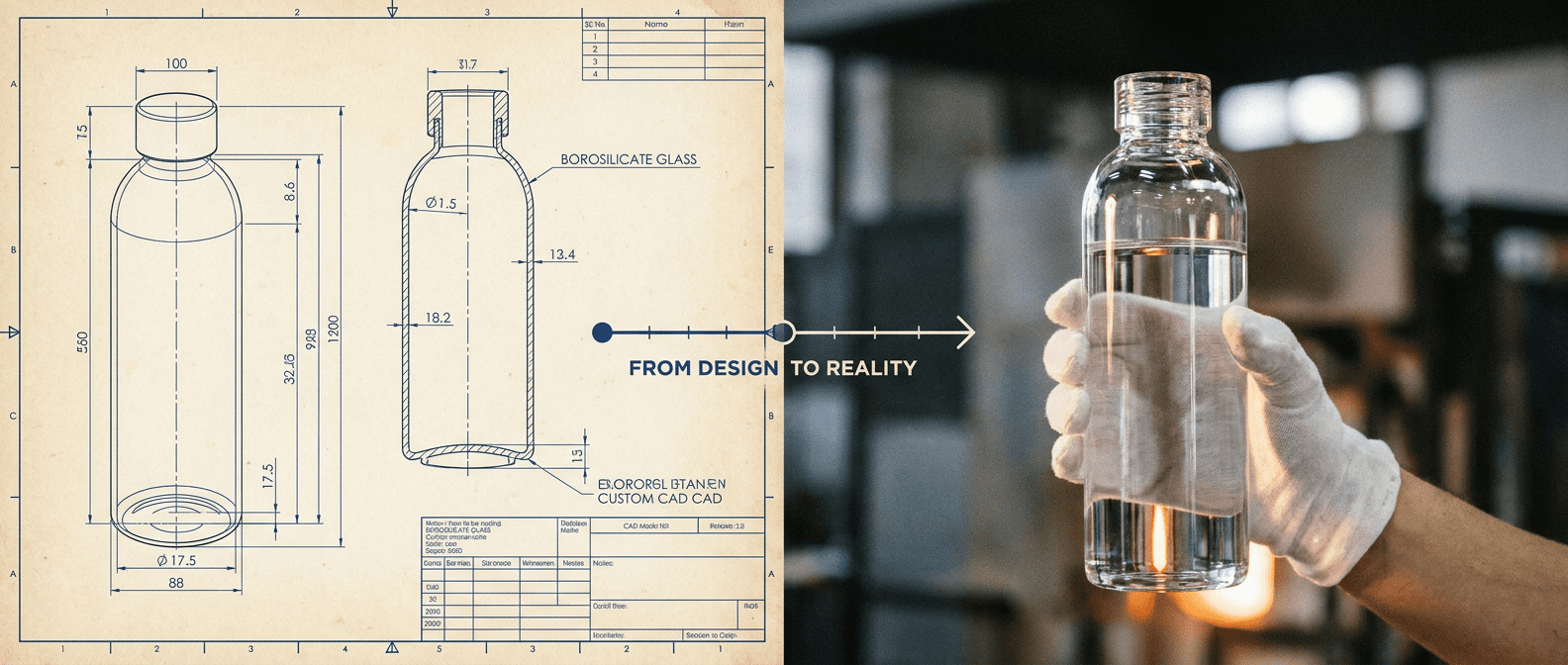
For school brands planning product line expansion, the 400ml mold can often share the same neck finish and lid tooling as a 300ml or 500ml variant. This reduces total tooling investment and simplifies lid inventory. Ask your manufacturer whether they can build a capacity family off a single base mold with interchangeable height inserts. It is a practical way to create SKU variety without multiplying mold costs.
Material Certifications Every School Brand Buyer Should Verify
Certifications are the baseline, not the guarantee. For children’s glass water bottles entering North American and European markets, three document sets matter: food contact safety, material composition, and social compliance.
| التصديق | ما يغطيها | Why It Matters for School Brands |
|---|---|---|
| FDA 21 CFR | Food contact material safety for US market | Verifies no harmful substance migration from glass to water |
| LFGB (German Food and Feed Code) | Food contact safety for EU market | More stringent than FDA on certain heavy metal limits |
| BPA-Free / Lead-Free Testing | Specific chemical absence verification | Essential for children’s product marketing claims |
| CE Marking | Product safety compliance for EU | Required for legal sale in European markets |
| BSCI | Social compliance and ethical manufacturing | Increasingly required by European school and institutional buyers |
The testing methodology matters as much as the certificate. For borosilicate glass, heavy metal leaching tests should follow EN 1388-1 or equivalent, using 4% acetic acid at 22°C for 24 hours for cold-fill products. If the bottle is marketed as suitable for hot beverages, the test conditions change to 100°C for the same duration. A manufacturer who cannot tell you which testing standard was applied to your product batch is operating on assumption, not verification.
One practice I recommend to school brand buyers is requesting a batch-specific test report rather than a general factory certificate. General certificates prove the factory was once capable of producing compliant products. Batch-specific reports prove your order was actually tested. The cost of batch testing is typically absorbed by the manufacturer for orders above 5,000 units, and it is worth specifying in your purchase agreement.
Customization and Branding for School Water Bottles
School brands have different customization requirements than general retail brands. The logo needs to survive daily handling, lunchbox friction, and repeated washing. School branding often includes mascots, house colors, or institution names that require more complex artwork than a simple corporate logo. The decoration method you choose directly affects durability and perceived quality.
Silk screen printing is the most common and cost-effective method for bulk orders. It applies ceramic ink to the glass surface, then fires the bottle through a decorating lehr at approximately 600°C to fuse the ink into the glass. The result is a logo that cannot be scratched off and survives dishwasher cycles. The limitation is color count—each color requires a separate screen and pass—and fine detail below 0.5mm line width becomes difficult to register accurately on curved surfaces.
Laser engraving offers finer detail and a premium frosted appearance, but it adds cost per unit and is better suited to smaller logos or text rather than large-area graphics. For school brands that want full-color mascot artwork, we use a combination of silk screen for the base logo and a decal transfer for the detailed color elements. Decal application is slower and more labor-intensive, so it increases unit cost by roughly 15 to 30 percent depending on complexity, but the visual result justifies the expense for premium school merchandise programs.
Packaging customization should be considered in parallel with bottle decoration. School brand bottles often ship in individual gift boxes or display-ready packaging rather than bulk cartons. If your bottle will be sold through the school office or at fundraising events, the unboxing experience contributes to perceived value. We offer custom box printing, foam inserts, and branded sleeve wraps. The lead time for custom packaging is typically two to three weeks longer than the bottle production lead time, so plan packaging artwork approval before the bottle order enters production.
Production Quality Control for Children’s Glass Products
Quality control for children’s glass products operates at a higher sampling rate than general drinkware. The default AQL (Acceptable Quality Level) for general glassware is typically 2.5 for major defects and 4.0 for minor defects under ANSI/ASQ Z1.4 sampling tables. For children’s products, I recommend and personally enforce an AQL of 1.0 for major defects and 2.5 for minor defects, which roughly doubles the sample size at each inspection gate.
The inspection stations we run for school brand orders include three checkpoints beyond the standard line inspection. First, every bottle passes through a polarized light stress viewer immediately after annealing. This is an automated station on our line that flags any bottle exceeding 8 nm/cm residual stress. Those bottles are crushed and returned to the cullet feed. Second, a 100% thermal shock test applies a 60°C temperature differential: bottles at room temperature are filled with water at 85°C, held for 30 seconds, then emptied. Any bottle that cracks is automatically rejected and the batch is flagged for process review. Third, a random sample from each pallet undergoes a 1.5-meter drop test onto a steel plate. The pass criterion is no breakage across 20 consecutive samples. If one bottle breaks, the sample size doubles to 40. Two failures triggers a full pallet quarantine and re-inspection.
These inspection gates add cost—roughly 3 to 5 percent to the unit price compared to standard drinkware QC—but for a school brand, a single broken bottle in a child’s hand erases years of brand trust. The cost of enforcement is negligible against the cost of a product safety incident.
A practical point for procurement managers: ask your manufacturer for the QC checklist specific to your order before production begins. A factory that cannot produce a written inspection plan with defined accept/reject criteria at each station is not operating a systematic quality program. The checklist should itemize the defect categories, sampling rates, measurement tools, and pass/fail thresholds. Review it. Question it. If the manufacturer resists providing this document, that is a signal worth noticing.
How to Plan Your School Brand Water Bottle Order
School brand orders have a seasonal rhythm that general retail orders do not. The peak procurement window for Northern Hemisphere school programs runs from January through March for delivery by June, ahead of the August school year start. Missing this window means either paying for air freight or accepting that your bottles arrive after the back-to-school sales period. I have watched buyers place orders in May expecting July delivery and then face the reality that custom mold production, decoration sampling, and sea freight collectively require 90 to 120 days from deposit to delivery.
The minimum order quantity for custom 400ml borosilicate glass water bottles with a school logo is typically 1,000 to 3,000 units depending on whether you are using existing molds or commissioning new tooling. Orders using our existing 400ml mold family can start at 1,000 units. If you need a proprietary shape or unique neck finish, mold development adds 15 to 25 days and the MOQ typically rises to 5,000 units to amortize the tooling cost, which ranges from $800 to $3,000 depending on mold complexity and cavity count.
Sampling follows a three-stage process. The first stage is a stock sample from existing inventory, which confirms the basic material, finish quality, and dimensional accuracy. The second stage is a pre-production sample with your decoration applied, which verifies logo placement, color registration, and packaging fit. The third stage is a production sample pulled from the first hour of the mass production run, which confirms that the line is producing to the approved standard. Each stage requires approximately 7 to 10 days for production and 3 to 5 days for express shipping. Budget four to six weeks for the full sampling cycle before committing to mass production.
If your school program involves specific safety requirements that go beyond standard certifications—such as compliance with a particular school district procurement policy or a third-party testing protocol like Intertek or SGS verification—share those requirements during the quotation stage, not after the order is placed. Retrofitting compliance testing into a product that is already in production is disruptive, costly, and often means re-running the decoration process if the original ink or lid material needs reformulation to meet the new specification.
What School Brands Should Ask Before Committing to an Order
How Do I Know the Factory Actually Produces Kid-Safe Bottles, Not Just General Drinkware?
The distinction between kid-safe production and general drinkware production shows up in the QC sampling rates, the residual stress limits, and whether the factory runs dedicated children’s product lines with tightened process parameters. Ask for the written QC plan specific to children’s products. If it lists the same AQL levels as general drinkware, the factory is not distinguishing between the two categories. In our facility, children’s bottle orders carry a separate inspection protocol with lower defect acceptance thresholds and mandatory 100% thermal shock testing. The documentation reflects the difference. If the documentation does not, assume the production line does not either.
What Happens If a Batch Fails Drop Testing After Production?
A failed drop test on a production sample triggers a specific sequence: the sample size doubles, the pallet is quarantined, and the annealing records for that production shift are reviewed. If the enlarged sample also fails, the entire pallet is rejected and remelted. The buyer should not bear the cost of a failed QC gate. Your purchase agreement should specify that QC failures identified by agreed-upon inspection criteria result in rework or replacement at the manufacturer’s expense. Do not accept a contract that charges the buyer for re-inspection or rework of defective product.
How Long Should I Budget from Deposit to Delivery for a Custom School Order?
For an order using existing 400ml molds with custom decoration: 90 days from deposit to FOB shipment. This breaks down as 15 to 20 days for pre-production sampling and approval, 25 to 30 days for mass production, 7 to 10 days for final inspection and container loading, and 25 to 35 days for sea freight to major North American or European ports. Air freight cuts the transit time to 5 to 7 days but triples the shipping cost. If your school program has a hard delivery deadline, share it during quotation and work backward to determine the latest possible deposit date.
Is a 400ml Glass Bottle Too Heavy for Young Children?
The filled weight of a 400ml borosilicate glass bottle with a standard stainless steel lid and a thin silicone sleeve is approximately 550 grams. For comparison, a 500ml stainless steel children’s bottle typically weighs 350 to 400 grams filled, and a 400ml Tritan plastic bottle weighs under 300 grams. Glass is heavier, and that is a real consideration. The tradeoff is material safety, taste neutrality, and durability against scratching. For school brands, we recommend pairing the 400ml glass bottle with a full-coverage silicone sleeve that adds grip and drop protection while keeping the total weight manageable. The sleeve adds about 40 grams.
What Lid Type Is Safest for School-Age Children?
A flip-top lid with a silicone seal and a locking mechanism is the most practical for classroom use. It allows one-handed operation, prevents spills inside a backpack, and does not have small removable parts that a child could lose or swallow. Threaded stainless steel lids with a carry loop are also common and durable, but they require two hands to open and the lid can roll away if dropped. For the youngest school children, we recommend the flip-top with a covered drinking spout. Share your target age range with the manufacturer during lid selection; the lid design should match the motor skills of the intended user.
If your school brand program requires a specific lid color, material specification, or safety feature that is not in the manufacturer’s standard catalog, send your requirements with your initial RFQ. Discussing lid options early prevents delays later. For questions about 400ml borosilicate glass water bottle customization, including lid compatibility, decoration methods, and batch-specific testing protocols, reach out at [email protected] with your school brand specifications and target order quantity.
إذا كنت مهتماً، اطلع على هذه المقالات ذات الصلة:
ابتكارات زجاج البورسليكات العالي مدفوعة بطفرة الاستدامة في أوروبا
زجاج البورسليكات مقابل زجاج البورسليكات والزجاج العاديزجاج الجير الصودا