 German
  English
  Arabic
  Spanish
 Multi-purpose Glasgefäßs are reshaping retail kitchenware aisles because a single jar design that accepts multiple lid types and fits a range of storage uses generates faster turnover and higher margins per SKU. For retailers and private-label brands, stocking a jar that works equally well for coffee beans, pantry flours, bathroom cotton balls, or even as a desk organizer reduces the inventory risk of single-function items. This versatility is not just a consumer trend; it rests on manufacturing choices—lid interchangeability, mold families, and glass quality—that directly determine how many shelf-ready variations a buyer can create without multiplying cost. Understanding that production layer helps you build a glass jar program that sells through consistently.
The Sales Advantage of Multi-Purpose Glass Jars
A jar sold only as a sugar container competes on price against every other sugar container on the shelf. A jar marketed as a general-purpose storage vessel, however, grabs the attention of consumers shopping for pantry organization, bathroom storage, craft supplies, and even small-batch fermenting. The wider the perceived use range, the larger the addressable customer pool for a single SKU, which means higher sell-through and fewer markdowns.
s)
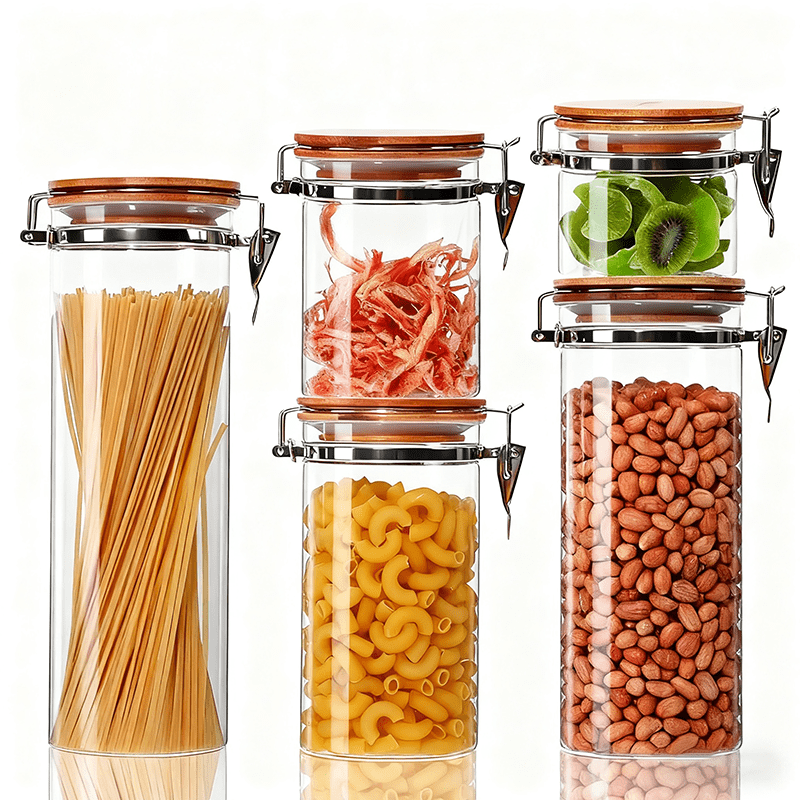
From a retail buyer’s perspective, this consolidation simplifies planogram decisions. Instead of stocking five single-function containers, a store can allocate the same shelf length to one or two multi-purpose glass jar families—each offered in two or three sizes—and still cover five consumer use cases. The reduction in SKU count lowers inventory carrying cost while maintaining visual variety, because the same jar body dressed with a bamboo lid looks entirely different on-shelf than one topped with a stainless steel lid. This is the mechanism that turns versatility into tangible retail sales growth, and it is why home-goods chains and specialty kitchen retailers are increasingly demanding jars from suppliers that can deliver more than a single size-and-lid combination.
How Manufacturing Versatility Creates SKU Variety
A multi-purpose glass jar program that generates retail volume is not designed in a marketing department; it is engineered on the production floor. The key variable is mold flexibility. At Xuzhou Jianmei Glass Products, we operate four automated borosilicate glass molding lines within a 40,000-square-meter plant, and we routinely run multiple capacities from one base mold family simply by adjusting the parison weight. A jar designed with a 63-mm neck finish, for example, can be blown at 300 ml for spice storage, 500 ml for coffee beans, and 1,000 ml for pasta without requiring a new set of forming tools. That single neck finish also accepts three lid types: natural bamboo wood, 304 stainless steel with a silicone gasket seal, and BPA-free snap-on plastic. The result is a nine-SKU family built from one mold investment, cutting tooling cost per SKU below what a single-function jar would require.
| Deckeltyp | Material | Siegel Typ | Best Retail Use |
|---|---|---|---|
| Bamboo Wood Lid | Natural bamboo | Silicone ring | Pantry display, gift-ready packaging |
| Edelstahl-Deckel | 304 stainless | Silicone gasket | Airtight storage for coffee, tea, spices |
| Snap-On Plastic Lid | BPA-free PP | Friction fit | Everyday kitchen organization |
| Korkdeckel | Natural cork | None (decorative) | Dry goods, houseplant propagation |
The manufacturing advantage extends to quality assurance. Our borosilicate glass jars pass FDA, LFGB, and SGS testing for heavy-metal leaching and thermal shock resistance, which is critical if a retailer promotes the jar as oven-safe or microwave-safe for meal prep—a claim that opens still more consumer use cases without changing the product itself. This combination of interchangeable lids, shared molds, and verified food-contact safety is what allows a retailer to launch a complete multi-purpose jar line without carrying five separate vendor relationships.
If your program involves multiple lid configurations across jar sizes, confirming mold and neck-finish compatibility before finalizing the bill of materials can save weeks of development time. Reach out at [email protected] with your specifications, and we will confirm which mold families match your requirements.
Private Labeling Multi-Purpose Jars for Higher Margins
Once the jar architecture is established, branding turns a commodity storage jar into a private-label asset. Multi-purpose jars are particularly accommodating to private label because the same glass body can be decorated with different logos, label positions, and color accents without altering the forming process. We have completed programs in which a single jar body was silk-screened with three different regional grocery-chain logos, and each resulting SKU shared the same protective packaging insert, keeping the unboxing experience consistent while lowering total packaging cost per unit.
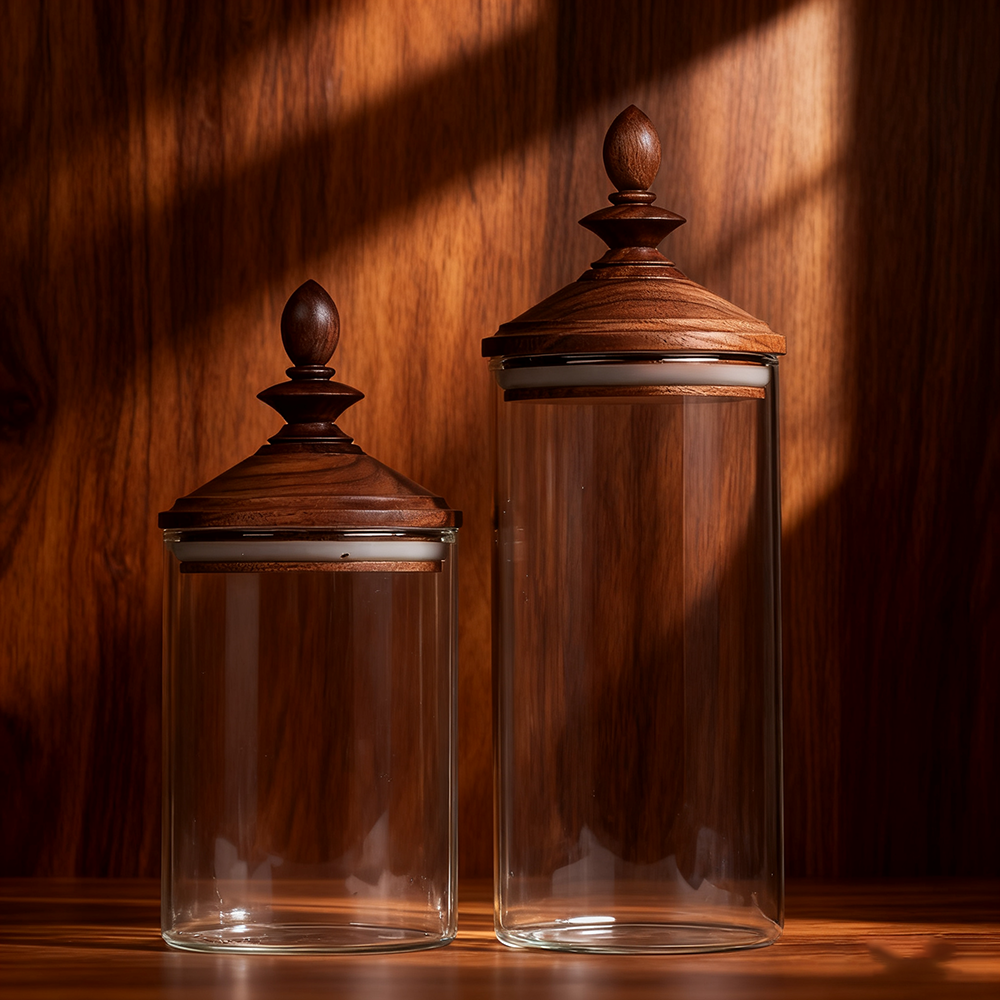
Customization methods available for borosilicate glass jars include high-temperature silk-screen printing for permanent logo application, laser engraving for premium gift lines, and full-wrap decal labels that can be adjusted between production runs. Minimum order quantities start at one piece for sample approval, and production MOQs typically begin at 500 pieces per SKU, with the understanding that capacity-sharing across jar sizes can often combine multiple SKUs into a single order fulfilment. The low threshold is feasible because the mold investment has already been absorbed by the shared-body strategy, leaving only setup and decoration changeover costs to allocate. For buyers who need a full branded line—say, three jar sizes, each with a bamboo lid and a logo-printed wooden tag—the total time from artwork approval to container loading is generally 25 to 35 days.
Logistics and Packaging for Retail Glass Jar Programs
Shipping glass jars profitably requires packaging engineering, not simply extra bubble wrap. We pack bulk jar orders with custom-molded pulp trays, one per layer, that isolate each piece and distribute stack pressure vertically through the carton walls. In full-container shipments, this method holds transit breakage below 0.5 percent across major routes to North America, Europe, and Oceania. For mixed-SKU containers—where a single shipment might carry 300 ml jars, 500 ml jars, and 1,000 ml jars—we design layered partitions that keep each size on its own tier, preventing weight shifts that concentrate force on smaller-diameter pieces.
Retail-ready packaging options include printed corrugated display trays that double as shipping protection, shrink-wrapped gift sets with insert cards, and individual gift boxes with foam lining. Because our plant produces 200,000 pieces of borosilicate glassware daily across 100 machines, seasonal surges—such as Q4 holiday pantry sets or spring organization campaigns—can be accommodated without splitting orders across suppliers.
A seasonal planning note: orders placed by early September typically clear Chinese national holidays and arrive in destination warehouses before November, which is when kitchen-storage retail traffic peaks. Working backward from your in-store date and building a three-week buffer for port congestion is a habit that has served our retail clients well.
Stocking Multi-Purpose Glass Jars That Sell Through
Adding a new product category always carries inventory risk, but multi-purpose glass jars spread that risk across multiple consumer use cases, which means a slower-selling size rarely becomes dead stock because it can be repositioned as a gift jar or a bathroom organizer without repackaging. The production strategy that makes this possible—shared molds, interchangeable lids, batch-flexible decoration—is available today, provided your supplier operates at a scale where mold investment is not a cost barrier to your program.
We have supported small retail chains launching their first glass storage line with as few as three SKUs, each drawn from an existing mold family and differentiated only by lid and label. The total development time, from sample approval to container dispatch, rarely exceeds 40 days when no new mold is needed. Send your part number and quantity requirements to [email protected]. We will propose a multi-SKU jar assortment that maximizes shelf impact at your target retail price point.
Common Questions Retailers Ask About Multi-Purpose Glass Jars
What is the minimum order quantity for custom glass jars?
For sample approval, you can start with a single piece. For production orders, the MOQ is typically 500 pieces per SKU. However, because our jar bodies often share the same mold family across capacities, we can frequently combine multiple size variations into one order to meet the minimum, effectively spreading the 500-piece requirement across a three-SKU set. This is one of the biggest operational advantages of a production line engineered for versatility rather than single-purpose tooling.
Are borosilicate glass jars really safe for food contact?
Some buyers assume that only thick soda-lime glass meets food-grade standards, but borosilicate glass actually contains fewer heavy-metal impurities than conventional glass. Our borosilicate glass jars pass FDA, LFGB, and SGS testing for lead and cadmium migration, and the material itself is non-porous, which means it does not retain odors or stains from previous contents—a real-world concern when a jar is marketed for coffee one month and spice storage the next. The lid seals are also tested for food-contact compliance, so the entire assembly meets regulatory requirements for direct food storage.
How long does it take to receive a custom glass jar sample?
It depends on whether a new mold is required. If the jar shape and size already exist in our mold library, sample production takes 7 to 10 working days, plus courier transit time. When a new mold must be fabricated, add 15 to 20 working days for tooling and trial runs. In either case, we send a pre-production sample by international courier, and you can request a second sample with decoration applied before giving the final mass-production approval.
Can I mix jar sizes and lid types in one shipment?
Yes. This is exactly how most retail programs are structured. We regularly consolidate 40-foot containers with multiple glass jar SKUs—for instance, 300 ml jars with bamboo lids, 500 ml jars with stainless steel lids, and 1,000 ml jars with snap-on lids—all packed in tiered carton configurations that protect each size group separately. The shipping documents break out each SKU by HS code and quantity, so there is no customs confusion at destination.
What packaging options do you provide for retail shelf display?
Beyond standard shrink-wrapping and gift boxes, many retailers now ask about shelf-ready packaging that reduces in-store handling. We offer printed corrugated display trays that act as both shipping protection and point-of-sale presentation, as well as individual gift boxes with foam inserts for premium lines. If your timeline is tight for a seasonal promotion, share your requirement dates, and we will confirm stock availability and packaging lead times. Reach us at [email protected] with your target in-store date and an outline of the jar capacities you need—we will return a production schedule and a proposal for shelf-ready packaging that fits your planogram.
Wenn Sie daran interessiert sind, sollten Sie sich diese verwandten Artikel ansehen:
warum Glas ein unverzichtbares Starprodukt für Ihre Regale ist
holiday seasons hottest seller alert
die besten Materialien für Trinkgeschirr Glas, Keramik oder Edelstahl
Was sind die Vorteile der Verwendung von isolierten Glasbechern?