 German
  English
  Arabic
  Spanish
 Wholesale buyers adding glass storage jars for zero-waste kitchens often begin with capacity and shape, then find returns coming from lid seal failures and thermal cracking. The production variables that decide whether a jar survives daily use are less visible: glass wall distribution, annealing control, seal compression, and certification traceability. This handbook sets out the checks our production team applies to borosilicate glass storage jars so you can compare suppliers on the points that actually show up in retail returns and warranty claims.
Why Do Zero-Waste Kitchens Need Glass Storage Jars?
Zero-waste retail sets fail when the jar is treated as a decorative object rather than a working storage vessel. A Glasgefäß that cannot hold a dry pantry cycle, a refrigerated leftover, or a hot rinse without stress will generate returns no matter how well the bamboo lid photographs. Most sourcing articles stop at the sustainability story. The shelf reality is that buyers need physical reliability first and the zero-waste claim second.
In our production runs, the same borosilicate jar shape can pass a visual inspection and still show hairline fractures after repeated dishwasher exposure if the annealing cycle was shortened or the wall thickness was uneven. We check glass jars the way we check drinkware: for stress points first. A 40,000 sq.m plant with 100 machines can produce 200,000 pieces daily, but volume only matters if the annealing furnace and blow mold settings stay consistent across shifts. That consistency is what protects a wholesale buyer from a beautiful sample followed by a weak production batch.
s)
What Material and Thermal Checks Matter for Glass Jars?
The first split is borosilicate glass against soda-lime glass. Soda-lime is cheaper and easier to mold, but it does not tolerate the rapid temperature change common in zero-waste kitchens, where jars move from refrigerator to warm water. High borosilicate glass, specifically 3.3 borosilicate, is the right base for a storage jar line that will be marketed as heat resistant. Our borosilicate drinkware lines are tested to a heat-resistant range from minus 20 degrees Celsius to 300 degrees Celsius, and the jar line follows the same material standard.
Thermal shock resistance is not a single specification. It depends on wall distribution and annealing as much as raw material. A jar with a thick base and thin sidewall can fail at a lower temperature swing than a uniform wall jar. Buyers should ask for three things at the factory level: glass type confirmation, wall thickness distribution, and the annealing curve used for the run.
| Verification point | What to specify | Failure mode when skipped |
| Borosilicate grade | 3.3 high borosilicate glass | Cracking after hot fill or cold storage |
| Wall distribution | Uniform sidewall and base thickness | Stress fractures at the base radius |
| Annealing control | Full annealing furnace cycle, not shortcut | Residual stress and unexplained breakage |
| Thermal shock | Required temperature swing and cycle count | Bottom cracks after rapid temperature change |
| Seal compression | Lid torque and silicone gasket contact | Moisture entry and aroma loss |
Which Lid and Seal Choices Keep Glass Jars Airtight?
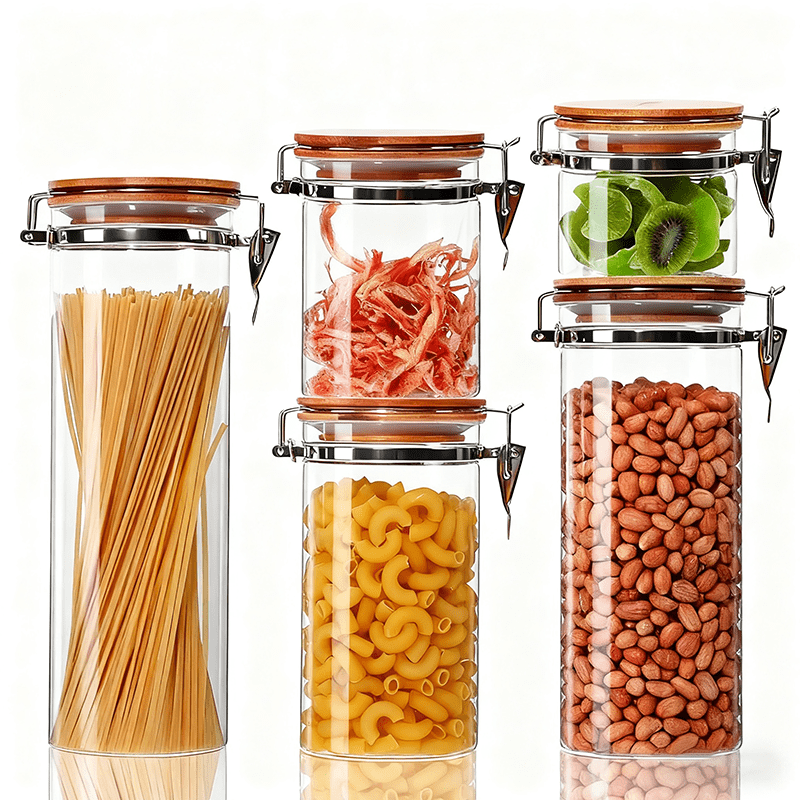
The lid is where most wholesale returns begin. A jar body can be flawless while the closure loses compression after repeated opening. We separate lids into three groups: screw-thread metal lids, bamboo or wood lids with silicone rings, and clip-top or wire bail closures. The right choice depends on the food category and the retail promise.
How tight should a lid seal be for dry goods?
Dry pantry goods such as oats, rice, and spices need a positive seal against moisture and insects, but they do not require the same compression as wet goods. The lid should close with a clear stop point and slight resistance. If the buyer can spin the lid with almost no torque, the seal is likely to fail during shipping or after a few weeks on the shelf.
Which lid types suit bulk pantry sets?
Screw-thread metal lids with food-grade silicone liners are the workhorse for bulk pantry sets because they stay consistent across large production runs. Bamboo and wood lids photograph well and fit the zero-waste aesthetic, but they are better for short-term or low-moisture applications unless the wood is treated and the silicone ring is thick enough. Clip-top jars create a strong visual point but add cost and are harder to pack in nested retail sets.
Are bamboo lids acceptable for long shelf life?
Bamboo lids can work for dry goods if the seal is a separate silicone gasket and the lid is not exposed to repeated washing or high humidity. For long shelf life in humid environments, metal or stainless steel lid systems with a silicone seal hold up better. We recommend bamboo for visual SKUs and metal for functional SKUs.
If your line mixes dry pantry storage with refrigerated wet ingredients, confirm the lid and gasket combination before you finalize the order. Send your storage conditions and lid preference to [email protected], and we can match the seal grade to those conditions instead of defaulting to a decorative lid that fails after a few months.
Which Certification Documents Should Wholesale Buyers Verify?
Certification is not a single piece of paper. A supplier can hold a wall full of certificates while the specific capacity and lid combination you order has never been tested. We tell buyers to ask for three layers: material-level tests, finished product tests, and factory compliance records. We hold 120 testing certifications covering FDA, CE, and other market requirements.
What does LFGB cover that FDA does not?
FDA compliance focuses on food contact safety for the US market. LFGB is the German food and feed code reference, and many EU buyers use it as the stronger signal for sensory and migration testing. For a zero-waste kitchen jar with a bamboo lid and silicone seal, the test should cover the glass body plus the lid and seal materials, not only the container.
When is a factory audit more useful than a certificate?
A certificate confirms a product passed a test on a specific date. A factory audit confirms the production system behind it. We keep testing records for food contact, lead-free, and BPA-free conditions across our jar and drinkware lines, and we arrange third-party pre-shipment inspection when the buyer requests it. For large or recurring orders, asking for batch-level test data is more protective than relying on a single certificate.
What Should You Send to Start a Wholesale Jar Quote?
Most jar quotes stall because the buyer sends only a photo and a target price, leaving the factory to guess at capacity, lid system, and volume. To get a production-accurate response, send three details: target capacities and dimensions, lid type and seal requirement, and estimated annual volume per SKU. If you need private label packaging or mixed container loading, include those notes in the same message.
Email [email protected] with your part number and quantity. We will confirm material range, existing mold availability, certification files, and sample lead time from our Jiangsu plant. Our minimum order is one piece for existing designs, so you can start with a sample before committing to full production.
What Questions Do Wholesale Buyers Ask Before Ordering?
Does a one piece minimum order include custom mold development?
The one piece minimum applies to existing designs and sample requests. Custom mold development is a separate project cost because the mold is made before production can begin. We evaluate the mold fee against your expected annual volume, and in many repeat orders the mold investment returns once the order crosses an agreed quantity. If you are testing a new shape, ask for a pre-production sample before mass production.
What lead time should first time buyers plan for?
It depends on whether the order uses an existing mold or requires a new one. Existing mold orders can move into production quickly after artwork and packaging approval. New mold development adds design review, mold fabrication, and pre-production sampling before mass production begins. First time buyers should plan extra time for sample approval and freight scheduling rather than assuming production is the longest step.
How do I confirm jars are food contact safe?
A wall certificate alone is not enough. Ask for lot-level test documents for the specific capacity and lid combination you are ordering. We test for BPA-free, lead-free, and food-grade conditions on the glass body and the lid or seal materials. For retail in the US or EU, request the matching FDA or LFGB report for that SKU rather than a general product line certificate.
Can one shipment mix jars with bottles and cups?
In mixed container orders we prepare jars, bottles, and cups from the same plant, so the answer is yes. Consolidating glassware lines reduces per unit freight and lets you test a broader zero-waste kitchen range without opening multiple supplier accounts. If you are combining capacities, confirm packing configuration before the order closes. Send your SKU list and target quantities to [email protected], and we will confirm packaging and loading with your forwarder.
Wenn Sie daran interessiert sind, sollten Sie sich diese verwandten Artikel ansehen:
Erschließen Sie Ihr Markenpotenzial mit UV-Druck
der ultimative Leitfaden für tägliche Aktionen zum Schutz der Erde