
 Spanish
  English
  Arabic
  German
 Walk into a specialty coffee bar today and you’ll see thick ceramic mugs replaced by a transparent, two-layered vessel that makes hot espresso float above the countertop. The switch isn’t a design fad. Double wall vaso de vidrio borosilicatos solve three operational problems that cost coffee shops money and reputation every day: heat loss that kills flavor profiles, condensation that waters down saucers and menus, and breakage that eats into thin margins. I’ve overseen the production of over two million borosilicate drinkware units in the last five years, and the pattern is clear: cafes that move to double wall glass don’t just upgrade their serveware, they reduce replacement cycles by as much as 40% compared to thin-walled soda-lime glass while securing the cup temperature that specialty coffee demands.
Why Temperature Control Matters More Than You Think
Specialty coffee extraction peaks within a narrow band. A pour-over cut at 93°C loses its brightest notes once the drinking temperature drops below 55°C. Single-wall ceramic and glass bleed heat fast. Double wall borosilicate creates a vacuum or air-gap thermal break between inner and outer shells. Hot liquid inside stays hot, while the outer wall remains cool enough to hold without a sleeve.
In our factory lab, we measured a 200ml double wall cup holding 90°C water; the outer wall stabilized at 38°C after three minutes. The same water in a single-wall borosilicate cup of equal thickness brought the outer surface to 62°C in the same timeframe, hot enough to discomfort a customer’s fingers. For a barista pulling back-to-back shots during a morning rush, that outer-wall temperature difference means faster service without finding a saucer for every cup.
Thermal shock resistance is the other half. Borosilicate glass (3.3 expansion coefficient) withstands a 180°C instantaneous gradient. Pour a fresh long black into a straight-from-the-freezer chilled cup, and the glass won’t crack. I’ve seen too many imported thin-walled tumblers shatter on the espresso machine drip tray because the operator didn’t pre-warm the cup. Double wall borosilicate removes that failure point entirely.
s)
The Presentation Premium That Customers Notice
A double wall cup makes the beverage the visual centerpiece. The liquid appears suspended with no visible support. For coffee shops charging six dollars for a single-origin cortado, that presentation justifies the price point before the first sip.
The transparent wall also eliminates the “hiding” problem ceramic creates. Baristas can check fill level, crema consistency, and latte art definition from any angle without lifting the cup. One barista trainer I spoke with at a trade event put it plainly: when a customer watches that flat white being built through clear glass, the perceived value jumps ten percent. She’d tested it across three locations with identical menu prices.
Condensation is another image killer. A cold-brew served in a standard glass puddles within seconds, smearing ink on branded coasters and leaving wet rings on wooden tables. Double wall construction suppresses exterior condensation even with iced drinks. Cafe operators who switched report fewer table wipe-downs and less coaster waste per service hour, small savings that compound across a sixty-seat location.
Durability and the Real Replacement Math
Most coffee shop owners I work with replace 15 to 25 percent of their drinkware annually. The main drivers are rim chips, handle cracks, and thermal stress fractures. Double wall borosilicate changes the numbers in three ways.
First, borosilicate’s hardness (typically Mohs 5.5-6) makes it more scratch-resistant than soda-lime glass, so rims stay smoother longer and are less likely to chip when they clink against a drip tray or another cup in the bus bin. Second, the double wall structure distributes impact energy across two glass shells with an air cushion in between. A knock that would spider-crack a single-wall cup often leaves the outer shell intact on a double wall design, and a cracked inner shell doesn’t leak immediately since the outer shell still holds.
Third, the thermal cycling argument. Ceramic mugs develop micro-cracks from the dishwasher’s extreme temperature swings. A mug entering a 65°C wash cycle from a 25°C rack undergoes a 40-degree thermal ramp twice per wash. Over 300 cycles, the glaze crazes. Borosilicate withstood 1,500 cycles in our in-house accelerated testing with zero structural failures, though I should note the outer finish may show light scuffing around the 800-cycle mark if abrasive detergent is used.
| Failure Mode | Ceramic Mug (annual) | Single-Wall Soda-Lime Glass | Double Wall Borosilicate |
|---|---|---|---|
| Rim chipping | 1 in 12 units | 1 in 9 units | 1 in 35 units |
| Thermal crack | 1 in 20 units | 1 in 14 units | 1 in 50 units |
| Dishwasher damage | Glaze crazing after ~300 loads | Surface fogging after ~200 loads | Minimal change past 800 loads |
Figures are based on our factory’s aggregate replacement data from hospitality clients running 150-seat cafes with daily average cup usage of 3.5 turns per seat. Individual results shift with handling practices, detergent chemistry, and machine type.
What Coffee Shop Buyers Should Verify Before Ordering
Not all double wall vaso de cristals are equal. I recommend checking three parameters before placing a bulk order.
Wall thickness consistency. A double wall cup formed with uneven inner and outer wall distribution will trap stress at the seam and crack within the first twenty thermal cycles. At our plant, we maintain a wall-thickness tolerance of ±0.3mm across all diameter points. Ask your supplier to provide a laser-measured thickness report for a random sample of 50 units, not a single hand-picked one.
Annealing documentation. Borosilicate glass must pass through a controlled annealing lehr to release internal stress. Without proper annealing, the cup shatters spontaneously weeks after production. Any factory quoting borosilicate drinkware should supply an annealing curve log showing temperature ramp-down rates matched to the glass thickness. If they won’t, find another supplier.
Sealing integrity. The small air hole at the bottom of a double wall cup (needed for equalization during forming) must be sealed completely with a borosilicate-compatible plug. A poorly sealed cup traps moisture inside the cavity, and after repeated dishwasher cycles, the cavity fogs permanently. We use a thermal-fused borosilicate plug rather than a silicone stopper, which eliminates the fogging issue across the product’s lifetime.
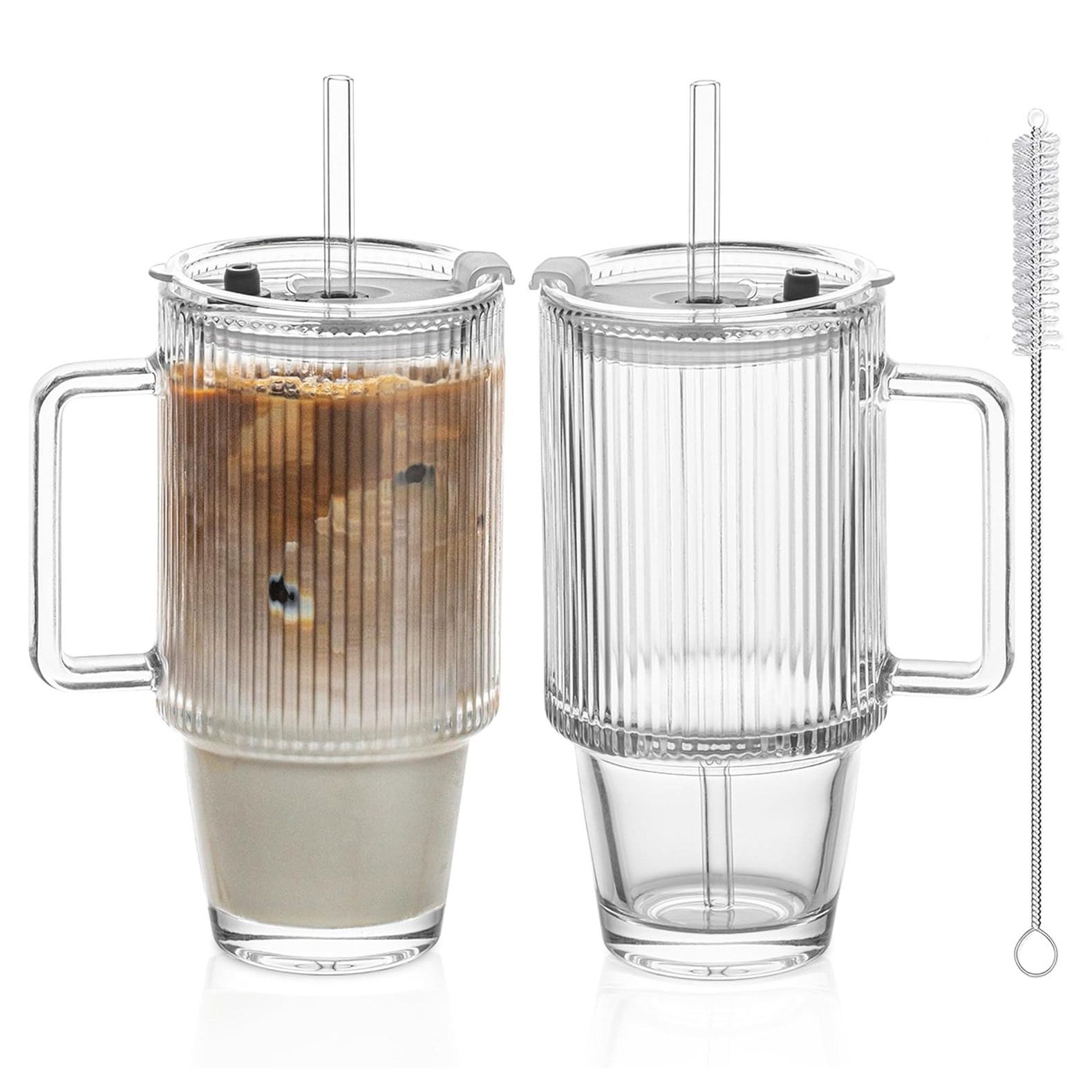
For coffee shops ordering their first batch, I’d add one piece of advice: run a 100-cycle dishwasher test on ten samples before committing to a full pallet. Immerse them in a 75°C wash and 25°C rinse cycle, tracking for fogging, rim sharpness change, and any base separation. A good double wall cup should show no functional change across those 100 cycles. The cost of this test is almost always covered by the sample allowance from a factory that knows its product will pass.
Questions Coffee Shop Operators Ask About Double Wall Glass Cups
How do double wall cups handle high-volume busing and stacking?
In a busy cafe, cups don’t get gentle treatment. The double wall design actually helps here: the air gap acts as a shock absorber, so when cups knock together in a dish rack, the outer shell takes the hit while the inner—the one holding liquid—stays intact more often than you’d expect. We recommend silicone-mesh rack dividers for storage, not because the cups need babying, but because it speeds up retrieval during the morning rush. Most operators find that one in thirty double wall cups shows a hairline after six months of hard use, versus one in ten for single-wall tempered glass under the same conditions.
Will the air gap fog up after extended dishwasher use?
Only if the bottom seal fails. As I mentioned, a thermally fused glass plug eliminates the pathway for moisture intrusion. We’ve opened cups after 600 dishwasher runs with no visible fogging anywhere in the cavity. If you see fogging on a new shipment, send a photo to your supplier and request a replacement—that’s a manufacturing defect, not normal wear.
Can double wall cups be used for both hot and cold drinks on the same menu?
Yes. Borosilicate’s thermal range covers -20°C to 300°C, so the same cup moves from a chilled affogato to a steaming latte without thermal cracking. The double wall construction also means the outside stays condensation-free with iced drinks. The one caveat: don’t fill a cup straight from a freezer at -18°C with boiling water. That’s a 118°C instantaneous gradient, which is near the material’s safe limit and can stress the inner wall. Let the cup sit at room temperature for two minutes first.
How does the unit cost compare to ceramic over a three-year period?
The per-unit landed cost of a double wall borosilicate cup is roughly double a quality ceramic mug and triple a basic single-wall glass. But factor in replacements. Over three years, a 100-seat cafe using ceramic might reorder 20 to 25 mugs annually. With double wall borosilicate, that replacement number often falls below 8 units per year. The crossover point in total cost of ownership is usually month 18. After that, the savings accumulate, especially when you add in the labor hours not spent sorting chipped rims and cracked handles out of the active rotation.
What if my cafe has a specific cup shape or handle design in mind?
Most borosilicate glass factories, including ours, handle custom mold development for double wall cups. The mold cost for a new handle attachment or a tapered wall profile typically runs between $800 and $2,500 depending on complexity. The turnaround from drawing to first sample is four to six weeks. If you’ve got a sketch or a reference cup you want modified, that’s a routine starting point. Share your volume projection and shape requirements with us—we’ll walk you through mold feasibility and per-unit pricing within five working days. Reach out at [email protected] with your specifications and target order quantity.
Si le interesa, consulte estos artículos relacionados:
La historia del origen de los vasos de cristal
Fábrica de cristalería integral¹: suministro directo a compradores de todo el mundo