
 Spanish
  English
  Arabic
  German
 Private label glassware can go from concept to finished product in 90 days, but the window shrinks fast if you misjudge the upfront mold decision. As a production manager overseeing high-borosilicate glass lines producing 200,000 pieces daily across a 40,000-square-meter facility, I’ve seen that timeline succeed when brand owners start with existing molds and submit clear design briefs in the first week. Delays in sampling, quality certification, or logistics can push that date, but a methodical schedule makes the 90-day target repeatable. Understanding the actual production cadence, not just design cycles, is what keeps a private label project on track.
Choose the Right Glass Mold for Private Label Production
When you launch a private label glassware brand, the single largest time variable is mold availability. Existing molds from a supplier’s catalog can move you directly into production within days. New mold development, however, adds 15 to 25 days for design, machining, and testing. We maintain a library of over 45 patented shapes for cups, jars, water bottles, and storage containers, covering most round, square, and tapered profiles. If your brand needs a unique silhouette, request a mold feasibility assessment before finalizing the design. A mold that requires complex undercuts or unusual wall thicknesses extends the timeline and complicates annealing. We’ve found that starting with a proven base shape and customizing surface elements—ribbed textures, logo etching, or color accents—delivers distinct branding without the schedule risk of a full custom mold.
Accelerate Design Approval and Private Label Glassware Sampling
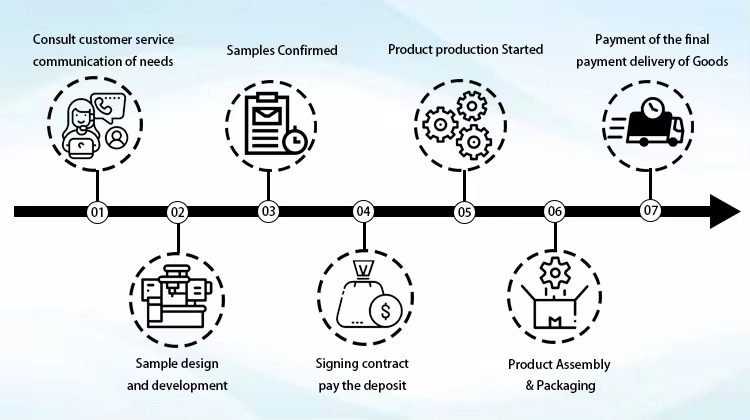
Once the mold is settled, the next gate is design approval and sample production. A detailed design brief that includes capacity, dimensions, lid type, sealing requirements, and packaging preferences cuts back-and-forth revisions significantly. When a buyer specifies a 500ml or 1000ml botella de agua de vidrio borosilicato with a 304 stainless steel lid and silicone seal, our sampling team produces a functional prototype in 10 to 14 days.
The common bottleneck is unclear color or finish instructions. We request a Pantone reference for logo printing and a physical reference sample for frosting gradients. Approve the pre-production sample only after testing for leak integrity, lid fit, and thermal shock resistance. Sending samples by air freight adds 5 to 7 days, so factor that in. To keep the 90-day window intact, commit to two sample rounds. The first round validates dimensions and function; the second confirms decoration and packaging.
Master Production Scheduling to Meet the 90-Day Window
After sample approval, production scheduling becomes the critical path. In a factory with 100 molding lines and daily output of 200,000 pieces, a standard 10,000-unit order runs through forming, annealing, and inspection in 15 to 20 working days. The timeline breaks down as follows:
| Escenario | Duration (Working Days) | Dependencies |
|---|---|---|
| Material Batch Preparation | 2–3 | Raw borosilicate tubing/cane availability |
| Molding and Forming | 10–12 | Mold cleanliness, machine calibration |
| Annealing and Cooling | 3–5 | Controlled ramping; 500–550°C stress relief |
| Surface Finishing and Decoration | 3–5 | Logo printing, frosting, or color application |
| In-line Inspection | 2–3 | Visual, dimensional, and thermal checks |
These durations assume no machine downtime and adequate raw material. One hidden factor is the annealing furnace cycle: 3.3 borosilicate glass requires a precise cool-down gradient to prevent residual stress that triggers cracking later. Rushing this stage can lead to field failures. So scheduling should include a buffer of 3 to 5 days for unplanned events. If your program involves multiple SKUs with different mold bases, confirm total line capacity and mold availability before locking the production schedule—reach out at [email protected].
s)
Secure Certifications and Quality Control Checks
Retail and food-contact glassware must carry recognized certifications. For the US market, FDA compliance is mandatory; for Europe, LFGB and CE marking. Our facility holds 120 testing certifications covering heavy metal leaching, thermal shock resistance, and food-grade safety.
Before mass production begins, request production-line samples for third-party lab testing if client specifications require it. In-house tests—drop tests, dishwasher cycle endurance, and microwave reheating tests—finish in one week. The FDA migration test for lead and cadmium can take 2 to 3 weeks, so plan concurrent testing with production rather than at the end. We coordinate with accredited labs for expedited reports. One practice we’ve adopted is running a 500-unit pre-production batch through the full inspection protocol. It identifies any process drift before full output.
Coordinate Packaging and Logistics for Final Delivery
Packaging design often slips until the end, but its lead time matches production. Custom boxes, polyfoam inserts, and instruction cards need 10 to 15 days for printing and assembly.
For international shipping, ensure the packaging meets ISTA 3A drop test standards to prevent breakage. Double-wall corrugated outer cartons with individual partitions work well for glassware. Work backward from your in-market launch date: subtract 25 to 35 days for ocean freight, 7 days for customs clearance, and 10 days for inland distribution. That leaves roughly 40 to 50 days for production and packaging, which fits squarely within the 90-day plan. Provide your supplier with UPC barcodes, labeling requirements, and palletization specs early to avoid rework.
Hitting a 90-day private label glassware launch hinges on production predictability. With an existing mold library, daily output of 200,000 pieces, and integrated quality testing, Xuzhou Jianmei Glass Products can deliver on that schedule. Send your product spec sheet and quantity to [email protected] to receive a production timeline tailored to your project.
Common Timeline and Production Questions
What if my design requires a completely new mold?
A new mold adds 15 to 25 days, but it does not rule out a 90-day window if the design is locked early. Mold cost ranges from $800 to $2,500 depending on complexity and cavity count. We recommend submitting a 3D CAD file for an upfront feasibility check to avoid re-machining delays. The machining queue and material hardness can shift the schedule, so confirm lead times with the tooling team before setting your calendar.
Can I combine multiple products in one order to maximize efficiency?
It depends on whether the products share the same mold base and decoration type. Grouping a 500ml water bottle, a 420ml tumbler, and a 300ml storage jar into one production batch reduces changeover time and can speed shipping. The constraint is that each item must use the same base material and finishing process. If one product needs a different mold coating or color application, the setup time increases and eats into the schedule.
How do I ensure my glassware complies with European regulations?
LFGB certification alone is not enough—CE marking covers structural safety too. For EU markets, migration testing for lead and cadmium per LFGB 30&31 and thermal shock resistance per EN 1183 are baseline requirements. Request a certificate of compliance for each batch, and, if your retailer requires it, a third-party test report from an accredited lab. In-house protocols cover these, and we manage the coordination with SGS or Intertek so testing runs parallel to production.
What is the minimum order quantity, and can I start small?
One piece—that’s the minimum for sampling, a number that often surprises first-time importers. Bulk production MOQ varies by product. A typical private label water bottle starts at a 1,000-unit trial order to prove market response before scaling to 50,000. A small batch still runs through the same mold, decoration, and quality systems as a large one, so you can test without sacrificing reliability. If you’re evaluating cost scenarios, send your product type and target quantity to [email protected]—we’ll outline the numbers specific to your plan.
Si le interesa, consulte estos artículos relacionados:
por qué 60 de los compradores transfirieron pedidos a esta fábrica china
Serie de artículos de cristal de borosilicato de Jianmei
elegir una fábrica china de vidrio